








📝 Summary
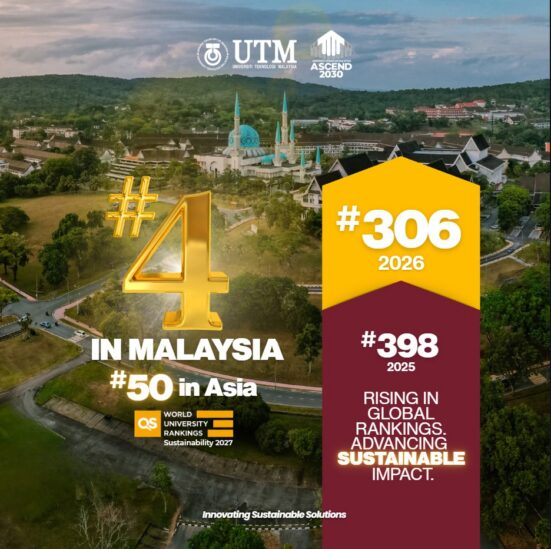
Universiti Teknologi Malaysia (UTM) has climbed 92 places to joint 306th in the QS World University Rankings: Sustainability 2027, ranking in the top 16% of 2,004 universities worldwide. UTM’s environmental sustainability score rose 18.9 points to 77.8, placing it in the global top 7%, and its social impact score rose 7.0 points to 80.1. The university’s Vice-Chancellor, Dato’ Prof Ts Dr Mohd Shafry Mohd Rahim, attributed the result to UTM’s strategic plan, UTM ASCEND 2030, which prioritizes sustainability.
JOHOR BAHRU, [17 November 2026] – Universiti Teknologi Malaysia (UTM) has climbed 92 places to joint 306th in the QS World University Rankings: Sustainability 2027, placing it in the top 16% of 2,004 universities assessed worldwide. UTM ranks 50th in Asia, ninth in Southeast Asia and fourth in Malaysia.
QS World University Rankings: Sustainability 2027 Results
UTM advanced in both of the ranking’s main categories, Environmental Impact and Social Impact, which together account for 90% of the overall result.
Within Environmental Impact, Environmental Sustainability recorded UTM’s largest improvement of any measure. This lens assesses how a university runs its own operations, including climate commitments, emissions, renewable energy and sustainability policy. UTM’s score rose 18.9 points to 77.8, lifting it 167 places to joint 140th and into the global top 7%. It now ranks 36th in Asia and third in Malaysia. Environmental Research also advanced 256 places, with a score of 85.9.
“Being ranked among the world’s top 7% for environmental sustainability shows that the way we run our own campus now matches what we teach and research,” said UTM Vice-Chancellor Dato’ Prof Ts Dr Mohd Shafry Mohd Rahim. “A 92-place climb is encouraging, but sustainability is judged by impact, not position. We will keep working until every part of UTM, from our operations to our governance, reflects our commitment to Innovating Sustainable Solutions.”
UTM’s environmental standing is also reflected in its people. Former UTM Pro-Chancellor Academician Tan Sri Dato’ Seri Dr Salleh Mohd Nor, recipient of UTM’s Honorary Doctor of Environmental Engineering, is one of Malaysia’s foremost environmental figures. His major contributions to environmental conservation, scientific research and the advancement of knowledge, along with his continued commitment to championing the sustainability of the natural world, span more than four decades. As the first Director-General of the Forest Research Institute Malaysia (FRIM), he built it into one of the world’s leading tropical forest research institutes. He led the Malaysian Nature Society for three decades, championing the protection of Endau-Rompin, in UTM’s home state of Johor, and Belum as national and state parks. Internationally, he became the first President of the International Union of Forest Research Organizations (IUFRO) from outside Europe and the United States in its 100-year history. He is also a recipient of the Merdeka Award in the Environment and Planetary Health category. His stature and legacy continue to inspire academics, researchers and future generations.
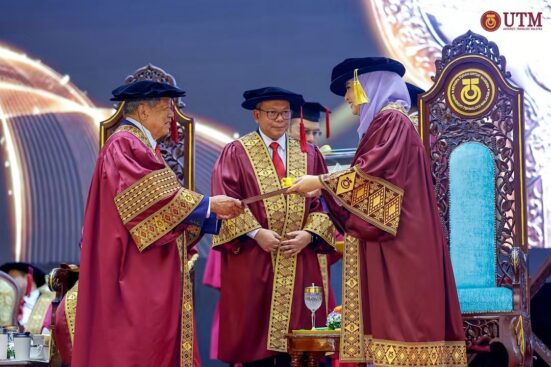
Former UTM Pro-Chancellor Academician Tan Sri Dato’ Seri Dr Salleh Mohd Nor, recipient of UTM’s Honorary Doctor of Environmental Engineering
Within Social Impact, Knowledge Exchange remains UTM’s highest-scoring measure at 94.4. It ranks joint 159th globally, within the top 8%, and 27th in Asia, UTM’s strongest regional position of any measure. Employability and Opportunities followed at 90.9, ranking eighth in Southeast Asia and fourth in Malaysia. UTM also made major strides in access and inclusion. Impact of Education rose 349 places on a 9.5-point score gain and now ranks ninth in Southeast Asia and fourth in Malaysia. Equality rose 218 places on a 12.5-point gain. Overall, UTM’s score rose 7.0 points to 80.1, its third consecutive annual increase from 67.5 in 2024, and improved in all 12 measures QS assessed.
The result follows UTM retaining 25th place in the QS World University Rankings: Asia 2027, announced earlier this month.
Dato’ Prof Ts Dr Mohd Shafry linked the result to the university’s strategic plan. “Sustainability is one of the four pillars of UTM ASCEND 2030, and this result is an early sign that we are heading in the right direction,” he said. “More importantly, we want to excel not only in performance but in purpose and impact on society. A university that runs its campus sustainably, opens its doors to first-generation students and brings its expertise to communities is exactly what ASCEND 2030 sets out to build.”
The rankings recognise work that links UTM’s expertise with its campus operations and the communities around it.
UTM is applying its expertise to clean energy and environmental protection. With Yayasan JCorp, UTM provided technical expertise for a 5.6 kWp solar photovoltaic system with battery storage at Sekolah Agama Tunjuk Laut, a rural school in Kota Tinggi, and trained teachers and JCorp staff to maintain it. With CIMB Bank, the Mangrove Sustainability Heroes programme brought volunteers, including UTM staff, to Tanjung Piai National Park to support mangrove conservation. On campus, “E-Waste: Let’s Recycle & Redeem Now” set up a dedicated collection point for unwanted electrical and electronic equipment.
UTM is also widening access to education and supporting student wellbeing. It allocated RM1.1 million in endowment scholarships to students, and philanthropy is helping to sustain that support. UTM received RM16 million in contributions this year, announced at the UTM Royal Gala Dinner 2026. The UTM Endowment Fund has raised RM183.72 million cumulatively and has awarded 1,013 Endowment Scholarships to students from lower-income families (B40) to date. Under the government’s SULUNG programme, first-generation students from B40 families receive university fee exemptions. Through Menu Siswa Rahmah, campus cafeterias offer meals at RM5 or less.
UTM continues to strengthen transparency and accountability in its governance. It publishes its administrative circulars, including those establishing the University Governance and Policy Committee and its Customer Support portal. Financial accountability is reinforced through compliance audits, covering procurement, payments and assets, and through courses and training for staff.
