






📝 Summary
Universiti Teknologi Malaysia (UTM) researchers are often overlooked when their own university’s research is published, despite contributing to earlier studies. This is due to factors such as lack of awareness of relevant studies within the institution, prestige bias, and competition for grants and publications. Proper citation is essential for scientific integrity and recognition of prior discoveries, and UTM researchers should strive to acknowledge relevant work from their own institution and others internationally.
Universities take pride in high-impact publications, international collaborations and global recognition. At Universiti Teknologi Malaysia (UTM), decades of research have generated substantial knowledge across engineering, science, the built environment and interdisciplinary fields.
Yet an uncomfortable question deserves attention: why are relevant research contributions from our own university sometimes overlooked when new findings are published? This is not a call to favour UTM publications or inflate citation numbers, but to recognise earlier scientific contributions fairly. Are we sufficiently aware of knowledge developed within UTM, and are we ensuring that it remains visible internationally?
The paradox of high-impact publishing
Having spent more than three decades in academic research, particularly satellite remote sensing and environmental applications, I have observed newer publications on subjects related to earlier UTM studies that did not acknowledge those contributions, including articles in prestigious Q1 journals. Some overlooked studies include work to which my colleagues and I contributed methods, datasets or findings.
I do not suggest that every paper on a similar subject must cite earlier UTM work. Scientific relevance, originality and methodological significance must determine whether a reference is warranted. However, where earlier work directly informs a new study, its omission merits reflection. Publication in a Q1 journal is an achievement, but a journal’s quartile alone does not guarantee a complete and balanced literature review.
Why might relevant research be overlooked?
Several factors may contribute. The volume of scientific literature makes comprehensive searches challenging and researchers may be unaware of relevant studies within their own institution. Separate networks among research groups, laboratories and faculties can also limit awareness of complementary work.
Prestige bias may favour prominent international authors or journals over equally relevant work by less visible groups. Competition for grants, publications and promotion can also encourage intellectual isolation. Healthy competition drives innovation, but excessive individualism weakens collegial exchange. Rivalry should not, however, be attributed as a motive for individual omissions without evidence.
Citation is scientific integrity, not institutional loyalty
We should never cite a paper merely because it comes from UTM. Equally, we should not overlook a relevant UTM paper simply because it comes from a colleague. References should establish scientific foundations, recognise prior discoveries and distinguish new findings from established knowledge. They must be justified by intellectual contribution, not friendship, affiliation or pressure.
This appeal rejects compulsory institutional citations, reciprocal citation arrangements and irrelevant references inserted to improve metrics. Self-citation is legitimate when authors build upon their previous findings, but excessive or irrelevant self-citation should be discouraged. The same standard applies to citations of colleagues’ work. The goal is responsible scholarly recognition, never citation inflation. Relevant work deserves acknowledgement whether it originates at UTM, elsewhere in Malaysia or internationally.
Building collective intellectual strength
Science is cumulative, with new discoveries building on earlier observations, datasets, methods and interpretations. UTM’s research strengths have grown across generations of scholars. In environmental remote sensing, water resources, industrial emissions, coastal ecosystems and infrastructure monitoring, different groups may contribute complementary findings.
Acknowledging relevant work helps readers trace developments, identify methodological advances and recognise contributions from multiple teams. This is particularly important for postgraduate students and early-career researchers learning from international literature and earlier scholarship. Proper referencing makes UTM research more discoverable internationally.
However, institutional impact cannot be reduced to citation counts. Citation practices vary by discipline, publication age and research topic. The ultimate measure is not how often we cite one another, but how meaningfully our collective research advances knowledge.
Strengthening UTM’s research culture
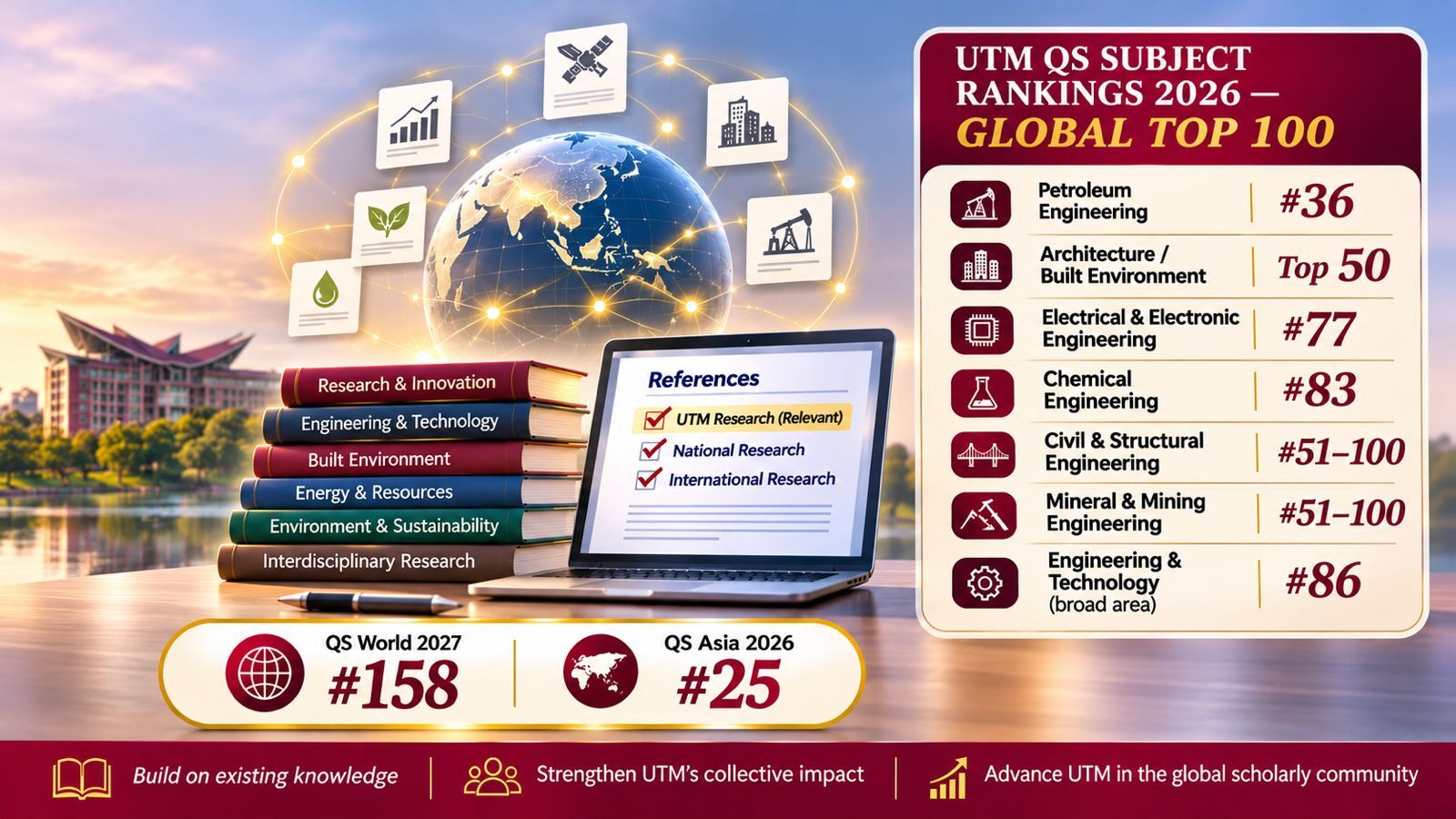
UTM’s QS World University Rankings by Subject 2026 results demonstrate its academic strengths: 36th in Petroleum Engineering, Top 50 in Architecture / Built Environment, 77th in Electrical & Electronic Engineering, 83rd in Chemical Engineering, and 51–100 in Civil & Structural Engineering and Mineral & Mining Engineering. Engineering & Technology was ranked 86th. UTM was also ranked 158th in the QS World University Rankings 2027 and 25th in QS Asia 2026. These achievements should encourage research visibility, not preferential citations.
Professors have a particular responsibility to nurture this culture. Researchers should conduct comprehensive literature searches covering international, Malaysian and institutional research. Cross-faculty seminars can help scholars discover complementary work, while supervisors should encourage students to evaluate earlier UTM studies critically, not cite them automatically.
Institutional repositories, accurate author profiles and consistent metadata can improve discoverability. These measures should support access, not quotas or mandatory citations. Professors must lead through fair acknowledgement and respect for contributions across faculties and generations.
A shared responsibility
Recognition must extend beyond congratulating colleagues on publications, grants and awards. It should include reading their findings, engaging with their methods and acknowledging relevant contributions. Scholars can recognise others’ work while identifying limitations and proposing improvements.
UTM’s future excellence will depend not only on publication volume or journal prestige, but also on the integrity, continuity and influence of the knowledge we create. Let us recognise previous contributions when they genuinely inform our work, while retaining the independence to question and improve them. We must never turn citation into institutional loyalty, nor allow valuable research to remain invisible simply because it comes from colleagues working alongside us.
We do not need to cite UTM research simply because it is ours. We need to ensure that when UTM research deserves recognition, it receives it.
“Cite with integrity. Recognise with generosity. Advance knowledge collectively. Together, let us build a better UTM in the global scholarly community.”
Prepared by Prof. Sr Gs. Dr. Mazlan Hashim, FASc, Chairman, UTM Council of Professors | Professor of Remote Sensing, Faculty of Built Environment and Surveying (FABU), Universiti Teknologi Malaysia (UTM)
