


📝 Summary
Universiti Teknologi Malaysia (UTM) hosted the ASEAN-ICT Virtual Organisation (ASEAN-IVO) Forum 2026, emphasizing human-centric digital innovation to address real-world challenges. The forum highlighted UTM’s commitment to mission-driven research and industry engagement, with a focus on creating meaningful impact for people and society. The event brought together international research leaders to discuss collaboration opportunities and showcase UTM’s research projects, such as AI-enabled rainfall prediction and X-Band Radar Information System.
KUALA LUMPUR, Nov 18 – Universiti Teknologi Malaysia (UTM) continues to strengthen its role in advancing research and innovation that address real-world challenges through digital technology, with an emphasis on creating meaningful impact for people and society.
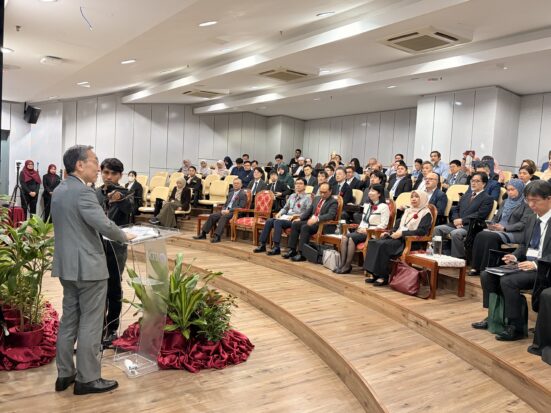
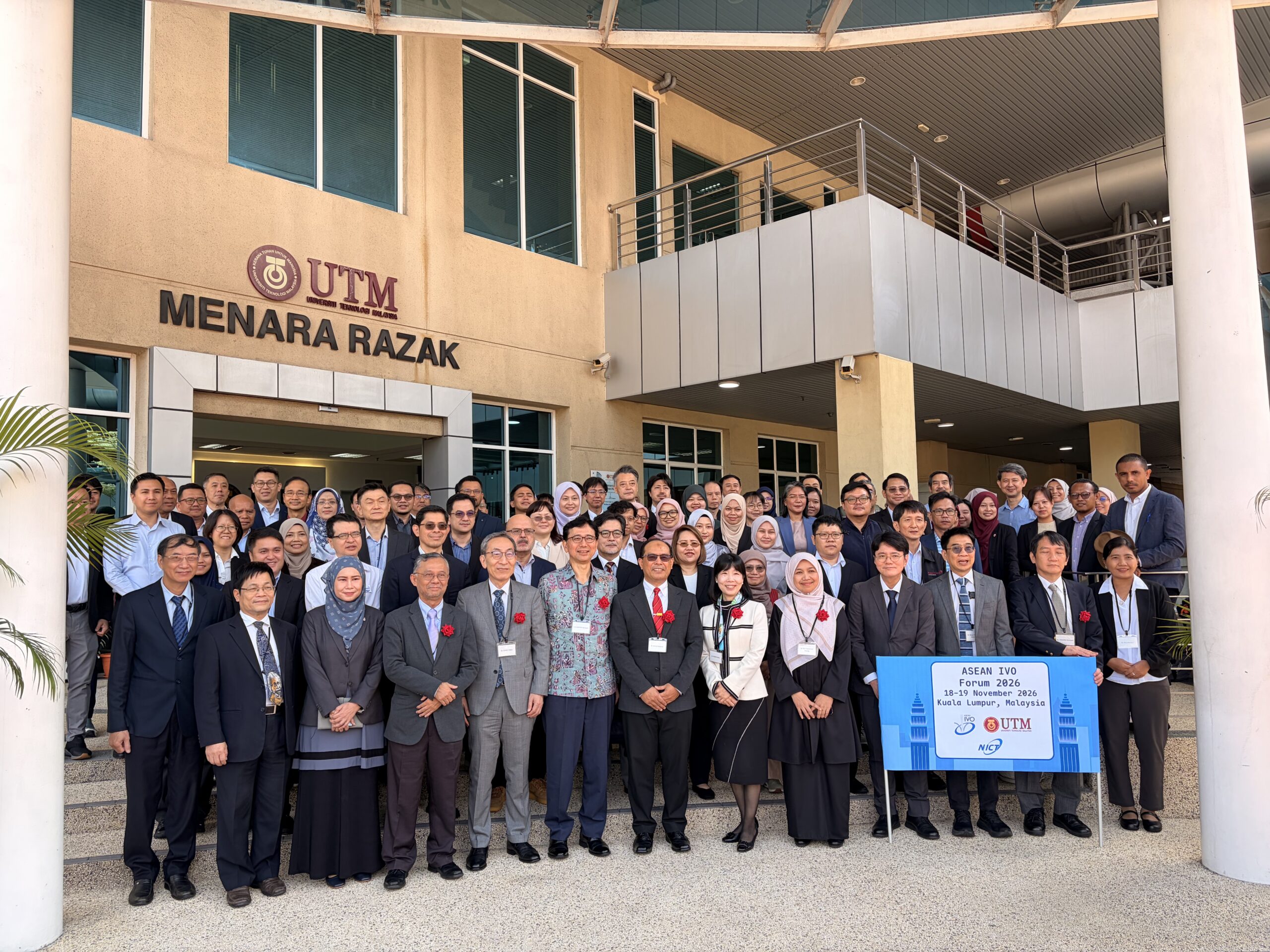
This commitment was highlighted at the ASEAN-ICT Virtual Organisation (ASEAN-IVO) Forum 2026, held at Dewan Seminar, UTM Kuala Lumpur, under the theme “Human-Centric Digital Horizons: Mission-Driven ICT Research for People and Society”. The forum was officiated by the Ambassador Extraordinary and Plenipotentiary of Japan to Malaysia, Shikata Noriyuki, underscoring the importance of Malaysia-Japan and wider Association of Southeast Asian Nations (ASEAN) cooperation.
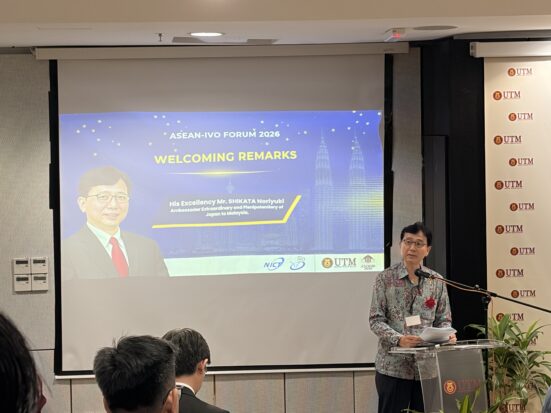
The forum brought together international research leaders, including the President of Japan’s National Institute of Information and Communications Technology (NICT), Dr. Ohno Hideo, as a collaborative partner, and Chair of the ASEAN-IVO Steering Committee, Dr. Moriai Shiho, as co-organiser. UTM was represented by Prof. Dr. Shamsul Sahibuddin, on behalf of the Dean of the Faculty of Artificial Intelligence (FAI).
In his keynote address, UTM Deputy Vice-Chancellor (Research and Innovation), Prof. Ts. Dr. Ali Selamat, emphasised that digital transformation should begin with people’s needs. Technology, he said, must go beyond technical capability and respond to challenges faced by communities and industries.
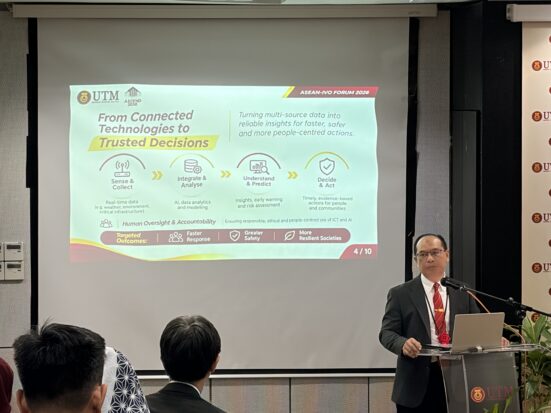
He outlined five Information and Communication Technology (ICT) frontiers for intelligent resilience: sensing and the Internet of Things (IoT); artificial intelligence (AI) and analytics; digital twins; resilient connectivity and immersive technologies such as augmented and extended reality (AR/XR). Cybersecurity and digital trust, he noted, must underpin their responsible adoption.
The approach is reflected in UTM’s artificial intelligence (AI)-enabled rainfall prediction research for the Kuantan River Basin, using rainfall data from 2009 to 2023. The study combines a Wasserstein Generative Adversarial Network with Gradient Penalty (WGAN-GP) to address missing data and a Broad Learning System (BLS) to predict rainfall. It reported an R² value of 0.942, while incremental learning enabled updates up to 600 times faster, with lower prediction errors based on root mean square error (RMSE) and mean absolute error (MAE) evaluation. The findings could help agencies make earlier, better-informed decisions and support community flood preparedness.
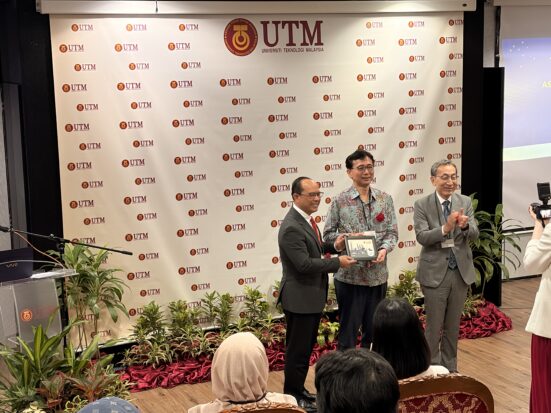
Another example is the X-Band Radar Information System (XRIS), developed through research at UTM Pagoh. The platform processes radar files every two minutes and provides real-time visualisation through a secure web dashboard for researchers, agencies and decision-makers. During testing, it recorded an average response time below 500 milliseconds and 99.87 per cent uptime over 30 days, with potential to improve access to rainfall intelligence.
Looking ahead, Prof. Ali highlighted three pathways for ASEAN-Japan collaboration: talent mobility through researcher and student exchanges, joint supervision and capacity-building; joint living laboratories to co-develop and test solutions in real settings and joint research and development proposals addressing shared regional priorities.
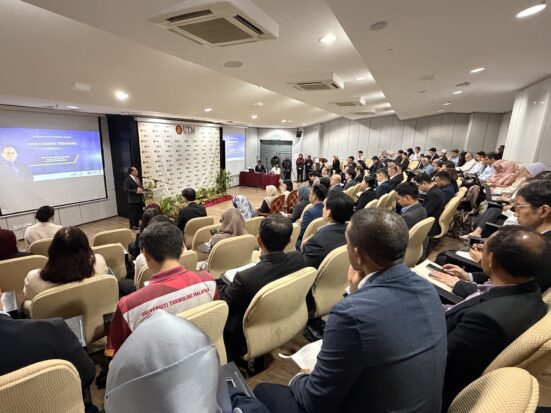
Aligned with UTM ASCEND 2030 and the UTM Strategic Plan 2026–2030, these efforts reflect the University’s focus on mission-driven research, industry engagement and responsible innovation. The forum reinforced a shared ambition to connect research, people and solutions across borders, ensuring that technological progress contributes to a safer, more inclusive and resilient ASEAN.