

📝 Summary
Malaysia is facing significant risks from oil shocks and climate change, which could lead to cascading consequences including energy cost surges, water supply disruptions, and food production declines. The country’s food, energy, and water nexus is highly vulnerable to these risks, and a prolonged West Asia conflict could exacerbate the situation. To mitigate these risks, Malaysia must accelerate its transition to renewable energy and improve energy efficiency, while also strengthening climate-resilient agriculture and water management systems.
Rising geopolitical tensions involving Iran, Israel and the United States (US) are once again placing global oil markets on edge, raising the risk of supply disruptions that could ripple across economies worldwide. At the same time, climate change continues to intensify extreme weather events, from droughts to floods, placing additional strain on already vulnerable systems.
Individually, these risks are significant. Combined, they are systemic.
“Today’s global risks are no longer isolated. Geopolitical tensions and climate change are interacting in ways that amplify systemic vulnerabilities across critical sectors,” said Prof. Ir. Ts. Dr. Sharifah Rafidah Wan Alwi of Universiti Teknologi Malaysia (UTM).
Around 20 per cent of global petroleum liquids consumption, or about 20 million barrels per day, flows through the Strait of Hormuz, according to the US Energy Information Administration (EIA) on June 16, 2025, underscoring its critical role as a global energy chokepoint. Any disruption in this corridor could trigger sharp increases in oil prices and global supply instability.
For Malaysia, the implications are immediate and complex. While higher oil prices may increase national petroleum revenues, they also raise domestic costs across electricity generation, transportation, food production and water services. Climate change further amplifies these pressures through erratic rainfall, prolonged dry spells and rising temperatures.
The situation is further compounded by the anticipated return of El Niño conditions, which are expected to bring drier weather, reduced water availability and heightened stress on agriculture and energy systems.
This convergence reveals a deeper structural issue: Malaysia’s food, energy and water nexus remains tightly interconnected and highly vulnerable to both geopolitical and climate shocks.
Understanding the FEW Nexus
The food, energy and water nexus, or FEW, refers to the interdependence between these three essential systems. Energy is required to treat and distribute water, water is necessary for agriculture and energy production, while food systems depend heavily on both energy and water inputs.
A disruption in one sector does not remain contained. It cascades across the others, amplifying risks throughout the economy.
“The food, energy and water nexus reflects real operational dependencies. A disruption in one system will inevitably cascade into the others,” Prof. Sharifah Rafidah explained.
A System Under Stress
Recent events have demonstrated how these risks are already materialising.
According to Berita Harian on Feb 9, 2026, declining water levels at Machap Dam and Gunung Pulai Dam reduced operations at the Simpang Renggam Water Treatment Plant to below 30 per cent of its 60 million litres per day capacity, requiring emergency measures to stabilise supply.
At the same time, geopolitical developments are beginning to affect water systems. In a statement reported by Media Selangor on March 17, 2026, the National Water Services Commission warned that disruptions to global trade routes due to the West Asia conflict could affect water supply continuity, given the sector’s reliance on fuel and imported chemicals, spare parts and equipment.
Globally, the International Energy Agency (IEA) in 2016 estimated that the water sector accounts for about 4 per cent of global electricity consumption, highlighting how energy shocks can directly translate into water risks.
With El Niño conditions expected to intensify dry spells, water reservoirs and hydropower generation could face additional pressure, further exposing the tight coupling between energy and water systems.
Food at Risk
Food systems are equally vulnerable, and recent developments indicate growing structural vulnerabilities.
According to New Straits Times on March 19, 2026, the Fertiliser Industry Association of Malaysia warned that a prolonged West Asia conflict could disrupt fertiliser supply chains, with shipping delays of 10 to 14 days, fuel consumption increases of up to 40 per cent, and significantly higher logistics and insurance costs.
Such disruptions could delay fertiliser application, reduce crop yields and increase food prices.
These risks are likely to be exacerbated by El Niño-induced drought conditions, which can reduce soil moisture, affect crop productivity and increase irrigation demand.
Malaysia’s structural exposure is further compounded by its reliance on imports. According to The Star on Feb 5, 2026, Malaysia’s rice self-sufficiency level remains at about 52 per cent, constrained by structural limitations, rising input costs and climate-related pressures.
If Risks Are Not Managed
Without proactive mitigation, the combined effects of oil shocks and climate change could lead to cascading consequences.
Energy costs could surge, increasing electricity tariffs and industrial operating costs. Water utilities could face rising treatment and distribution costs, affecting supply reliability. Food production could decline due to higher fertiliser costs and climate variability.
“We are no longer dealing with single-point failures. What we are seeing is systemic risk — where multiple stresses occur simultaneously and reinforce each other,” she stressed.
At a systemic level, this could result in inflationary pressures, supply disruptions, reduced industrial competitiveness and increased fiscal burden, ultimately affecting household affordability and national stability.
Renewable Energy as a Strategic Response
Malaysia must accelerate its transition towards renewable energy, particularly through decentralised solutions such as solar photovoltaic systems.
Programmes such as the Solar ATAP programme (2026) enable households and businesses to install rooftop solar systems and export excess electricity to the grid. Meanwhile, the Corporate Renewable Energy Aggregation Mechanism (CREAM) in 2025 allows aggregation of distributed solar generation, enabling broader participation in clean energy systems.
Efficiency as a Strategic Buffer
Alongside renewable energy, Malaysia’s Energy Efficiency and Conservation Act (EECA) 2024 plays a critical role.
The Act mandates that large energy users appoint registered energy managers, conduct regular energy audits, implement energy management systems, submit annual energy reports, and comply with minimum energy performance standards.
These measures systematically reduce energy demand and exposure to global price volatility across the FEW nexus.
From Efficiency to Resilience
However, technical measures must be complemented by forward-looking risk planning.
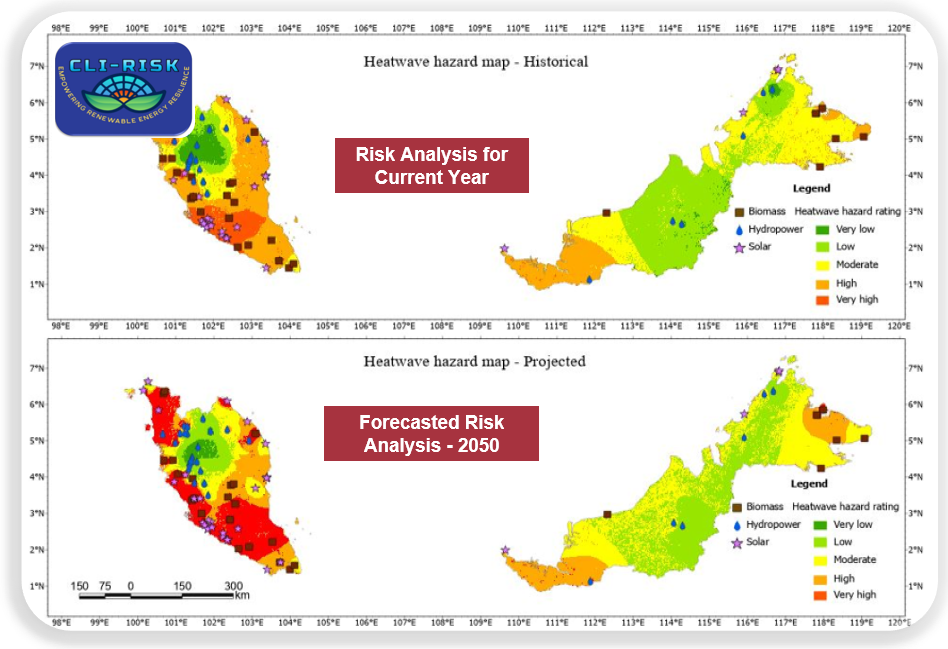
This is where CliRisk becomes highly relevant. Developed by Prof. Ir. Ts. Dr. Sharifah Rafidah Wan Alwi and her team at UTM, CliRisk evaluates how renewable and hydropower systems perform under future climate scenarios.
“Climate resilience must be designed into energy systems from the outset. Tools like CliRisk allow us to anticipate system vulnerabilities and take preventive action before disruptions occur,” she explained.
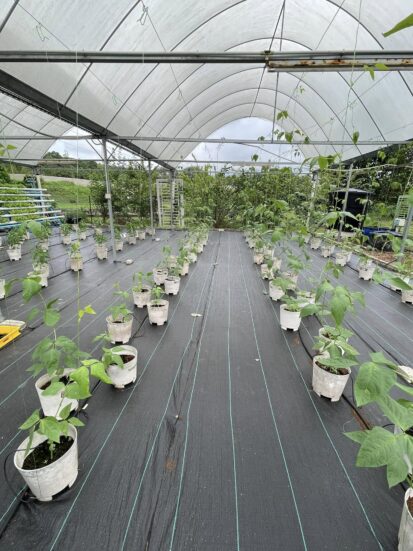
At the same time, Malaysia must strengthen climate-resilient agriculture. A strong example is the UTM Eco-Park initiative, which integrates fertigation, aquaponics, composting, biogas systems and solar-powered microgrids, supported by IoT-based monitoring and rainwater harvesting systems.
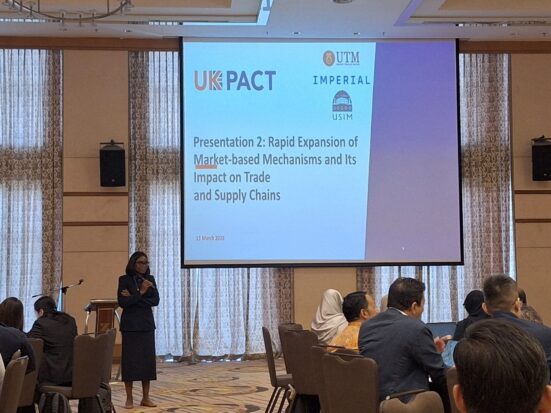
Beyond research demonstration, Universiti Teknologi Malaysia is also contributing at the policy and capacity-building levels. UTM is currently leading the Domestic Emission Trading Scheme (DETS) study under the UK PACT programme in collaboration with the Ministry of Natural Resources and Environmental Sustainability (NRES), Imperial College London and Universiti Sains Islam Malaysia (USIM), supporting Malaysia’s transition towards a structured carbon market.
In parallel, UTM will soon introduce a Master in Energy Transition and Management, aimed at developing future talent equipped with the interdisciplinary skills required to address energy, climate and sustainability challenges.
What the Public and Industry Must Do
Resilience is not solely a government responsibility.
Households can adopt rooftop solar systems, improve energy efficiency and explore small-scale urban farming to enhance food security. These steps reduce reliance on external systems while lowering costs.
For the industry, the response must be strategic. Companies should move beyond minimum compliance under the EECA 2024 by investing in renewable energy, adopting advanced energy management systems and conducting climate risk assessments across operations and supply chains.
Agricultural players must adopt precision farming, efficient irrigation systems and alternative fertiliser strategies to cope with both climate variability and supply disruptions.
The Real Question
The convergence of oil shocks, climate change and El Niño represents a new operating reality.
Malaysia is not facing isolated risks, but interconnected systemic challenges.
“The question is not whether these disruptions will occur, but whether Malaysia is prepared to manage them. In an uncertain world, efficiency reduces cost, but resilience ensures continuity,” she concluded.
