
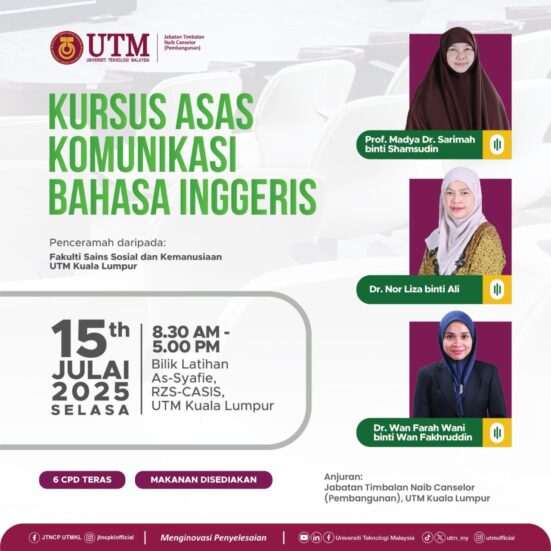
KUALA LUMPUR, July 15 – Universiti Teknologi Malaysia (UTM), through a strategic partnership between the Office of the Deputy Vice-Chancellor (Development) (JTNC(P)) and the Faculty of Social Sciences and Humanities (FSSH) Kuala Lumpur, successfully launched the first series of the Kursus Asas Komunikasi Bahasa Inggeris on July 15, 2025. This foundational English communication course was specially designed to meet the diverse communication needs of UTM’s support staff—including drivers, technicians, and hostel management personnel—who often serve as the university’s first point of contact for students, visitors, and external stakeholders.
The programme, held at UTM Kuala Lumpur, attracted 30 participants from various support staff grades, including H1, N1, JA5, JA10, and NA2. This initiative aligns with UTM’s larger vision of empowering its workforce to excel in a globally connected and multilingual environment. By strengthening the English proficiency of its frontliners, UTM reinforces its commitment to internationalisation, inclusivity, and professional development for all staff tiers.
The three sessions were thematically structured under the titles “Oh My English!”, “Handle With Care!” and “You Got This!”, each designed to simulate authentic workplace communication challenges. The sessions employed an experiential learning approach that encouraged active participation, role-plays, and the use of contextual language in frontline settings.
Empowering Communication for Real Workplace Situations
The course comprised three interactive sessions delivered by language experts from FSSH Kuala lumpur. Each session focused on practical language applications relevant to the participants’ daily tasks. Rather than offering generic English language instruction, the course was uniquely tailored to suit the operational realities and communication contexts encountered by support staff.
The programme opened with a dynamic session titled Session 1: Oh My English! – English for Counter Service, facilitated by Assoc. Prof. Dr. Sarimah Shamsuddin. This session focused on helping participants differentiate between acceptable and unacceptable etiquette and use polite, friendly language when communicating in English at the counter. One of the highlights was the segment on Mistakes, Facts & Mixing Blunders, which explored common missteps and awkward expressions often used in customer-facing interactions. Learners were introduced to practical and culturally appropriate English phrases, enabling them to project professionalism and warmth when engaging with clients.
“This course is not about grammar drills or exams. It’s about helping our frontliners feel confident, seen, and respected in their roles,” said Dr. Sarimah. “When they greet someone with a confident ‘Good morning, how can I help you?’, that makes a world of difference in first impressions.”
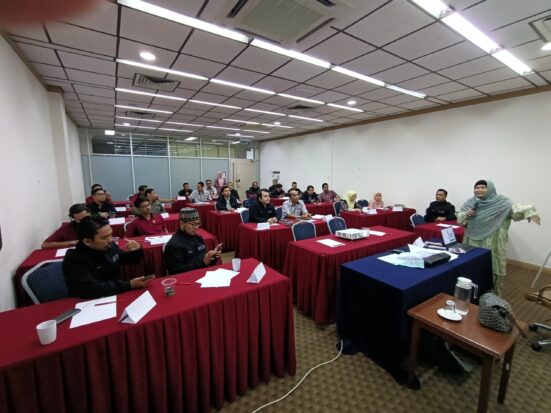
Session 2: Giving Instructions & Handling Questions was led by Dr. Nor Liza Haji Ali. This session introduced participants to essential English phrases for guiding visitors, issuing instructions, and managing everyday service encounters. Exercises included providing directions (“Go straight,” “Turn right”), handling frequently asked questions (“Where is the canteen?”), and responding to requests for assistance in a clear and respectful manner.
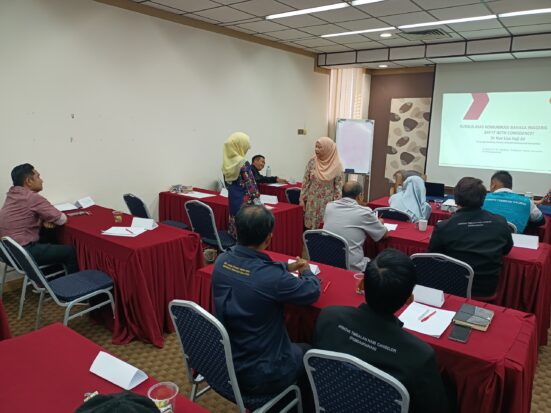
“Support staff are often the first people our international students meet on campus,” said Dr. Nor Liza. “Their ability to communicate calmly and helpfully—even with just a few simple phrases—can shape someone’s entire impression of UTM.”
In the final segment, Session 3: You Got This! Real Talk, Reflection & AI Tools, facilitated by Dr. Wan Farah Wani Wan Fakhruddin, allowed participants to reflect on their actual work experiences. They shared both their proudest service moments and their most difficult encounters with language barriers. Group activities involved role-playing customer complaints, guiding lost parents, or managing minor emergencies such as a power trip or a missing room key.

A highlight of the final session was the introduction of artificial intelligence (AI) tools to support language use. Participants explored free platforms, such as Google Translate, Grammarly, and ChatGPT, to see how AI could assist them in crafting polite and accurate responses. Each group compared their original answers to AI-generated suggestions and discussed ways to improve tone, clarity, and confidence.
“AI is not replacing you,” explained Dr. Wan Farah. “But it can help you say what you already know—better. These tools are here to make your job easier and more effective.”
Internationalisation Starts with Empowering Everyone
The course also served as a reminder that internationalisation at a university is not limited to academic mobility or English-speaking lectures. It begins at every entry point—from the gate, to the van, to the hostel lobby. As Malaysia continues to welcome more international students, every staff member plays a vital role in delivering a consistent, respectful, and positive experience for both guests and students.
Participants left with printed handouts, a simplified English FAQ list relevant to their job scopes, and the knowledge that AI is not a threat but a helpful ally. More importantly, they walked away with renewed confidence to use English in small but significant ways.
This successful training marks the first of a planned series of language empowerment workshops under the JTNC(P) and FSSH Kuala Lumpur collaboration. The positive feedback from participants has sparked interest among other departments in conducting similar training tailored to their team’s operational language needs.
“We are proud to lead a programme that places equal emphasis on empowerment, internationalisation, and technological literacy for all UTM staff,” said Dr Nor Liza. “Our support staff are the unsung ambassadors of UTM’s values.”
A Commitment to Service Excellence
This initiative is part of UTM’s broader commitment to continuous professional development and service excellence. As Malaysia’s premier research university, UTM recognises that quality service is not only about systems and infrastructure, but also about human interaction. Empowering frontline staff with the confidence to communicate in English effectively is a step forward in improving the overall experience of UTM’s diverse community of students, staff, and visitors.
“Kursus Asas Komunikasi Bahasa Inggeris” stands as a shining example of how targeted, context-specific language training can enhance the day-to-day service delivery of an institution. More than just grammar or vocabulary, it provided UTM’s frontliners with practical, culturally appropriate, and confidence-boosting communication skills, reinforcing their role as the welcoming face of the university.
The Faculty of Social Sciences and Humanities Kuala Lumpur hopes to continue offering similar programmes to support staff in various departments and at different skill levels. Plans are underway to explore intermediate and advanced modules in the future, as well as course customisations based on department-specific service scenarios.
UTM welcomes enquiries from other PTJs or departments interested in arranging similar courses. For more information, please contact the Faculty of Social Sciences and Humanities, Kuala Lumpur (FSSHKL).
Prepared by: Dr Wan Farah Wani Wan Fakhruddin, Dr Nor Liza Haji Ali and Assoc. Prof. Dr Sarimah Shamsudin
