


📝 Summary
Dr. Uswah Khairuddin, a Senior Lecturer at Universiti Teknologi Malaysia (UTM), has completed the first year of the Eric and Wendy Schmidt AI in Science Global Faculty Fellowship at Imperial College London. She is applying AI to rainfall modelling for better flood-risk prediction in Malaysia, and the fellowship has provided her with opportunities for technical learning, collaboration, and international collaboration. The second year of the fellowship will allow her to carry the work back to UTM, sharing new methods and research practices with students and colleagues.
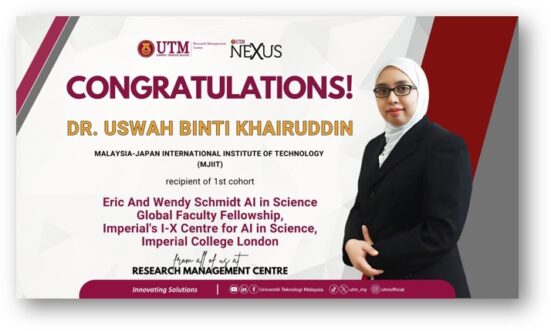
Ts. Dr. Uswah Khairuddin, Senior Lecturer in the Department of Mechanical Precision Engineering at the Malaysia-Japan International Institute of Technology (MJIIT), Universiti Teknologi Malaysia (UTM), has completed the first year of the Eric and Wendy Schmidt AI in Science Global Faculty Fellowship at Imperial College London. She joined the inaugural cohort in September 2025 after selection through UTM and Imperial’s evaluation process.
The year in London placed her within both a disciplinary research group and a cross-disciplinary artificial intelligence (AI) community, creating daily opportunities for technical learning and collaboration. It also gave her protected time to deepen her research and strengthen her AI skills.
Supported by Schmidt Sciences and hosted through Imperial’s I-X Centre for AI in Science, the two-year fellowship places each fellow at Imperial for one year before research continues at the fellow’s home university for a second year. Three annual cohorts of eight fellows began in September 2025, with one or two places expected for UTM academics in each cohort. A related Mini Visit programme offers 12 academics from partner institutions a shorter research placement of two to six weeks.
AI Research for Rainfall and Flood Risk
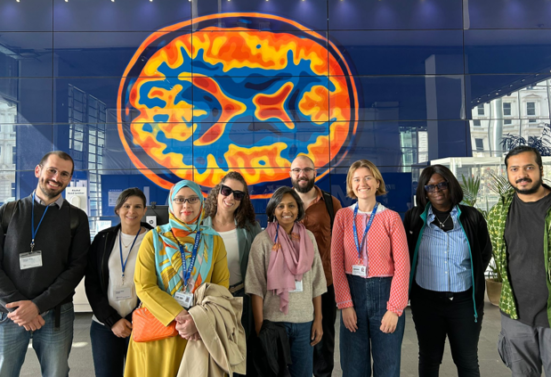
At Imperial, Dr. Uswah is based in the Department of Civil and Environmental Engineering with Prof. Wouter Buytaert from Hydrology and Water Resources. Her project applies AI to rainfall modelling for better flood-risk prediction during extreme climate events in Malaysia. It examines how AI can support rainfall downscaling and forecasting while keeping the scientific problem at the centre of model development.
Working within a hydrology group has helped her connect computational methods with the practical needs of water and climate research. She also works at I-X alongside AI postdoctoral researchers and fellows from other scientific fields. Technical workshops, seminars and regular exchanges between fellows have exposed her to methods beyond her usual area. This combination of AI expertise and close contact with domain scientists has encouraged a more interdisciplinary approach to research and supervision.
International Collaboration and Knowledge Exchange
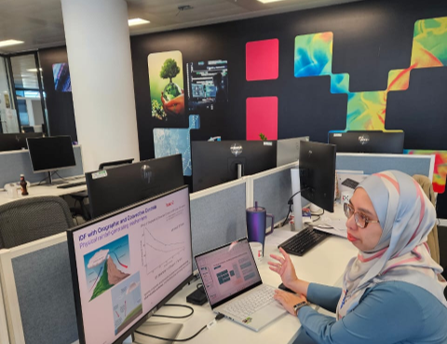
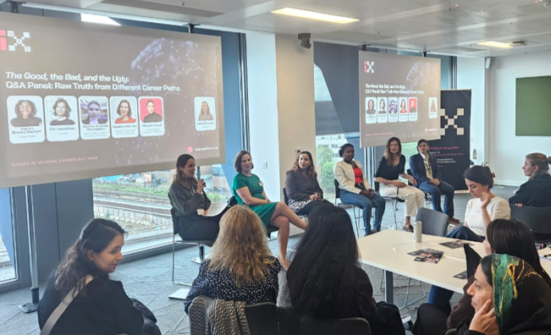
The fellowship has also created opportunities to contribute to Imperial’s research community. Dr. Uswah served as a social coordinator at I-X and supported an I-X Women in AI career event. These activities widened her professional network and reinforced the value of knowledge moving in both directions between visiting fellows and their hosts.
Working with members of the first fellowship cohort, she led a successful application to the Schmidt Community Initiative Fund. The group secured approximately USD 79,800 to organise an AI workshop in Brazil in 2027 and is planning a Global Faculty Fellows conference immediately afterwards. The initiative shows how relationships formed through the programme can develop into collaborative activities beyond individual research projects.
Bringing the Benefits Back to UTM
The second year is designed to carry the work back to UTM. Funding for a teaching buyout protects research time, while the remaining flexible research allocation is managed through UTM’s Research Management Centre. Dr. Uswah has continued supervising postgraduate students throughout the fellowship and plans to share new methods, research practices and international connections with students and colleagues. The structure therefore supports both an individual project and longer-term institutional links between UTM and Imperial.
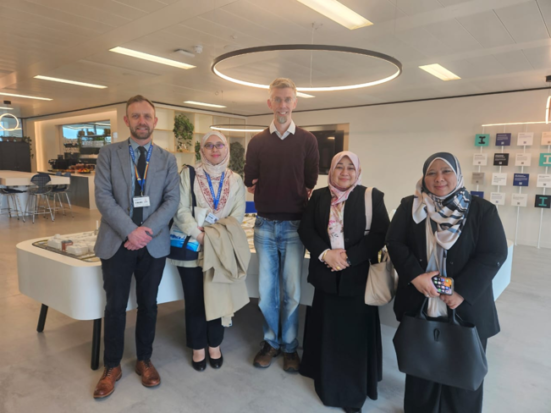
The experience is closely aligned with the four Pillars of Distinctive Eminence in UTM ASCEND 2030. Collaboration with Imperial supports Leap in Niche Excellence through high-impact research and international partnership. New methods and networks contribute to Global Talent when they are transferred through teaching and supervision. AI-driven rainfall and flood-risk research supports Sustainability, while the longer-term transfer of useful knowledge and technology to agencies and communities relates to Humanity and Well-being.
Opportunities for UTM Academics
UTM is the programme’s only Malaysian partner. Two UTM academics joined the second full fellowship cohort in September 2026, and six others were selected for the 2026 Mini Visits. For prospective applicants, Ts. Dr. Uswah recommends identifying an Imperial host whose scientific expertise matches the problem to be addressed, discussing the research idea early and developing the proposal together. Full fellowship proposals first undergo evaluation by UTM’s Research Management Centre before shortlisted applications proceed to Imperial, while Mini Visit applications are submitted directly to I-X.
After one year at Imperial, the fellowship has enabled Ts. Dr. Uswah to enter a new research field, strengthen her AI practice and establish international collaborations with clear relevance to UTM. Its long-term value will depend on how the resulting knowledge, networks and research opportunities are shared at UTM during the second year and beyond.
By Ts. Dr. Uswah Khairuddin, Senior Lecturer, Department of Mechanical Precision Engineering, Malaysia-Japan International Institute of Technology, UTM
