

The rapid acceleration of digital technologies and artificial intelligence (AI) has transformed far more than how systems are built. It has reshaped how organisations make decisions, how governments deliver public value, and how societies negotiate trust, ethics, and accountability in an increasingly automated world. In this context, computing can no longer be understood narrowly as technical skill or code. It must be understood as a discipline that shapes systems, institutions, and human outcomes.
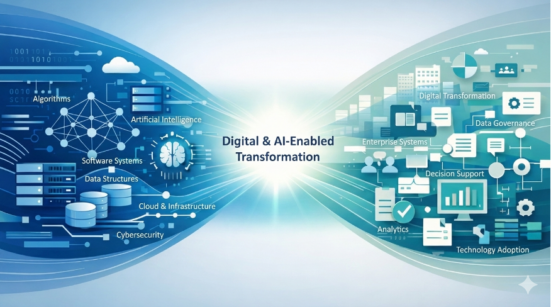
In this article, computing is used in its broad disciplinary sense, encompassing both Computer Science (CS) and Information Systems (IS). Together, these fields form the intellectual backbone of digital and AI-enabled societies. Computer Science focuses on technological creation, advancing the foundations that make digital innovation possible, while Information Systems ensures that these technologies are applied purposefully, governed responsibly, and embedded effectively in real-world contexts.
Computer Science and the Limits of Capability
Computer Science provides the core capabilities that underpin digital and AI innovation. Through advances in algorithms, software engineering, distributed systems, cybersecurity, and machine intelligence, it expands the technical limits of computation. These foundations enable large-scale data processing, secure digital infrastructure, and increasingly sophisticated AI models that now permeate everyday life.
As AI systems grow more complex and pervasive, Computer Science continues to push boundaries by developing more powerful learning architectures, more resilient systems, and more efficient computational frameworks. Yet technical sophistication alone does not determine whether such systems succeed, fail, or produce unintended consequences.
Information Systems and the Reality of Use
This is where Information Systems plays a critical and complementary role. Information Systems focuses on how digital and intelligent technologies are designed, governed, adopted, and sustained within organisations and societies. Rather than treating technology as an isolated artefact, it recognises digital systems as inherently socio-technical, shaped by the interaction between people, processes, institutions, policies, and culture.
In an era where AI increasingly influences public services, healthcare, education, and enterprise decision-making, this perspective is indispensable. Expertise in enterprise architecture, systems analysis and design, data and AI governance, and ethical, human-centred technology use ensures that innovation delivers value not only in theory, but in practice, aligned with organisational goals, societal norms, and public trust.
Why Integration Matters
Globally, academic structures for Information Systems vary, reflecting different historical and institutional trajectories. In some regions, IS is located within business schools; in others, within computing or interdisciplinary faculties. Across Southeast Asia, however, a clear strategic pattern has emerged. Leading universities increasingly position Information Systems within computing or information technology faculties, recognising that effective digital and AI systems demand both deep technical capability and systems-level understanding.
For Malaysia, this alignment is particularly significant. As the nation advances its digital economy and AI ambitions, separating technical capability from governance, context, and application would constitute a strategic weakness. AI is not merely a technological challenge; it is simultaneously an organisational, ethical, and societal one.
A National Imperative in the AI Era
Responsible AI adoption requires governance frameworks that ensure transparency, fairness, and accountability, enterprise architectures that align technology with institutional mission and strategy, and a deep understanding of human–AI interaction, risk, and trust. These challenges sit precisely at the intersection of Computer Science and Information Systems.
Malaysia’s evolving digital and AI policy landscape, including the establishment of the National AI Office and the AI Technology Action Plan 2026–2030, reflects this integrated view. Capacity building, governance, talent development, and responsible deployment are treated as inseparable components of national progress. Higher education institutions therefore carry a critical responsibility to educate graduates who can both build intelligent systems and lead their application responsibly.
UTM’s Integrated Computing Philosophy
At Universiti Teknologi Malaysia, this integrated philosophy underpins our approach to computing education and research. The Faculty of Computing advances knowledge at the convergence of Computer Science and Information Systems, ensuring that technological innovation is accompanied by governance, contextual understanding, and societal relevance.
This commitment is reflected in UTM’s recognition as a Premier Digital Tech Institution by the Malaysia Digital Economy Corporation. The renewed status for the 2026–2028 period acknowledges not only technical excellence, but also strong industry collaboration, graduate employability, and leadership in emerging domains such as artificial intelligence, data-driven systems, and digital infrastructure.
Beyond Building Technology
In an age defined by rapid technological change, universities have a responsibility that extends beyond producing advanced systems. They must also cultivate the intellectual frameworks needed to govern, contextualise, and apply those systems wisely. By treating Computer Science and Information Systems as an integrated discipline, UTM is positioned to contribute meaningfully to Malaysia’s digital and AI journey, developing not just capable technologists, but thoughtful leaders equipped to navigate complexity, uphold responsibility, and deliver lasting societal value.
About the Author
Assoc. Prof. Dr. Noorminshah A. Iahad is an Associate Professor at the Faculty of Computing, Universiti Teknologi Malaysia (UTM), and serves as President of the Malaysia Association for Information Systems (MyAIS), a national chapter of the global Association for Information Systems (AIS). Her work focuses on Information Systems, digital transformation, analytics, and the responsible adoption of digital and AI technologies, particularly at the intersection of technology, organisations, and society.
