
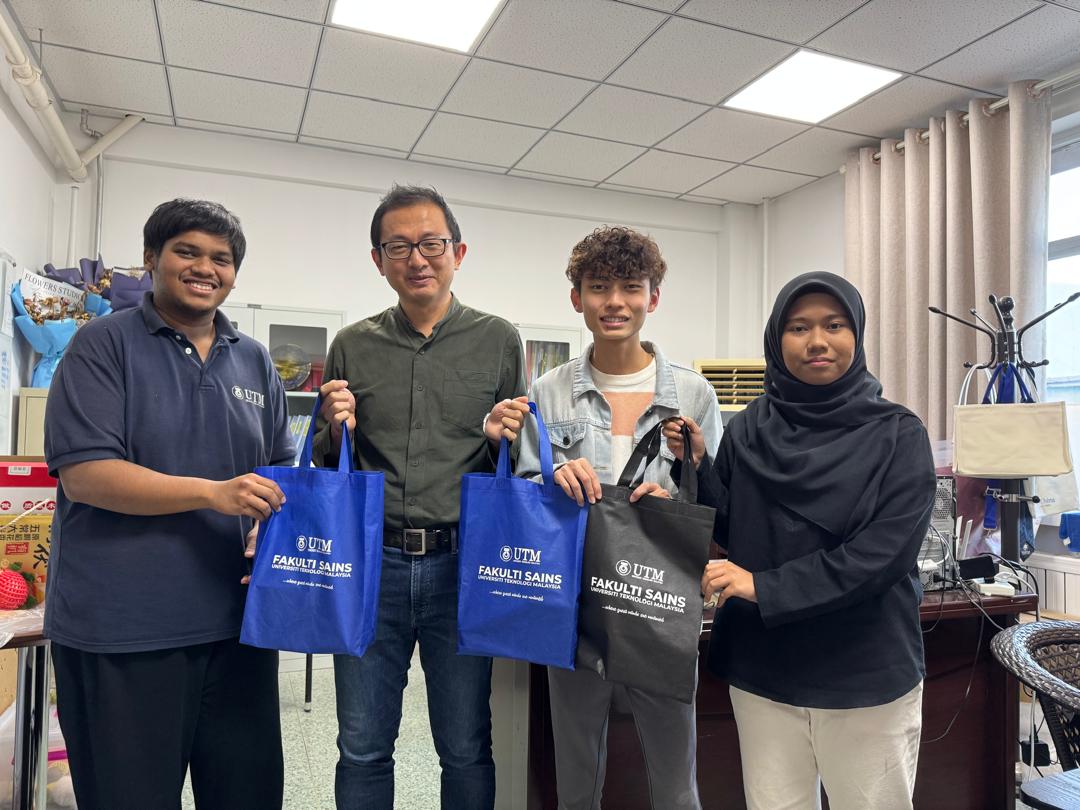

Three students from the Faculty of Science, Universiti Teknologi Malaysia (UTM) recently completed a three-month research internship at the Institute of Modern Physics (IMP), Chinese Academy of Sciences (CAS) in Lanzhou, China. Ong Boon Tong, Mayvin Lim Mohan, and Izatie Erdelina Sharizan was supervised by Prof. Ong Hooi Jin, who is a postdoctoral researcher originated from Malaysia, and currently leading the Department of Radioactive Ion Beam Facilities at the IMP. The institute is internationally recognised for its advanced particle accelerator facilities and its contributions to nuclear and particle physics research.
This valuable opportunity originated from the PERFiK National Physics Conference held last year, organized by the Institute of Physics Malaysia (IFM). During the conference, Prof. Ong Hooi Jin participated as one of the invited speakers, where he presented his current research to the audience. Coincidentally, Dr. Koh Meng Hock from the Department of Physics, Faculty of Science, UTM, approached Prof. Ong and learned that he was seeking young Malaysian physicists who are enthusiastic about fundamental nuclear research and interested in being nurtured as the next generation of scientific talent. This initial connection paved the way for the students to gain exposure to advanced research activities at IMP. Dr. Koh also provided crucial assistance in communicating with Prof. Ong and guiding the students through the necessary procedures to apply for funding such as from the School of Undergraduate Studies (UGS).
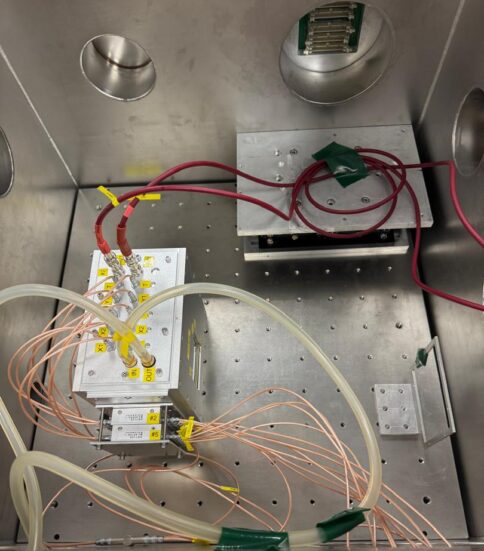
During their internship, they were assigned with the project focused on investigating the performance of a detector commonly used in accelerator systems, known as the Parallel Plate Avalanche Counter (PPAC). PPAC detector plays a crucial role in identifying and tracking charged particles in high-energy nuclear experiments. Their work involved analysing the position resolution of the detector, as well as studying its working principle and associated electronics. This was carried out through an experiment focused solely on calibrating the detector. The data collected from the experiment was then further analysed using computational methods with the ROOT software. Through this project, they gained experience in data analysis and developed useful computational skills.
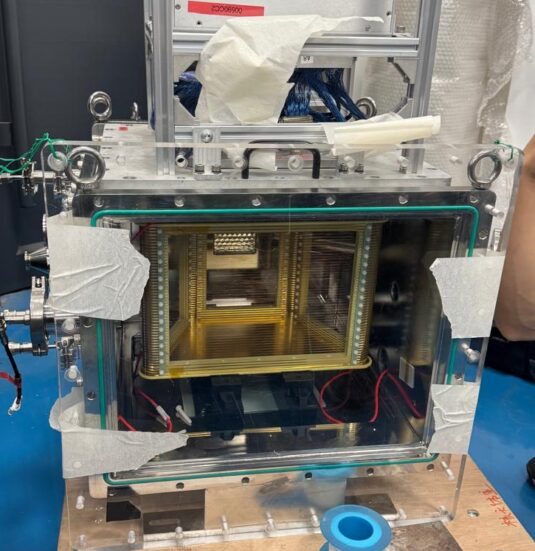
They were also tasked with performing data analysis using a Time Projection Chamber (TPC), which is one of the most sophisticated particle detectors used in the field today. The detector was mainly used to reconstruct three-dimensional particle tracks and identify particles which were responsible for the tracks, being dubbed as an electronic bubble chamber. In recent years, this leading-edge particle detector has made remarkable discoveries and findings in the field of Nuclear Astrophysics, High Energy Physics and Heavy ion Physics. This assignment has also exposed them to essential simulation software such as Geant4 and SRIM-2013, reinstating the importance of simulations in the world of physics.
One of the most memorable moments for them was seeing a full-scale research particle accelerator for the first time. They shared that they were amazed by the sophisticated technology and the level of expertise required to build and operate such a large and complex machine. They described the accelerator as a ‘massive magnetic metal giant’. Standing inside the experimental hall felt unreal and reminded them of how far science has advanced, as well as how much more there is still to discover.
Beyond research activities, the internship offered valuable cultural and academic exposure. The students had the opportunity to interact with international researchers, postgraduate students, and experts from various backgrounds. The exchange of perspectives, work habits, and scientific approaches enriched their understanding of global research collaboration. Life in Lanzhou also allowed them to experience the everyday lifestyle of the local community. The people there were very welcoming and treated foreign students kindly, sometimes even giving them priority in daily situations. Their warmth made the students feel a sense of belonging and comfort during their stay.
Reflecting on the internship, the students shared that the experience strengthened their interest in pursuing research in nuclear and particle physics. “Being in that environment made us realise that science is more than just equations and theories. It requires passion, patience, and attention to detail. This internship gave us the confidence to continue exploring research in the future.”
Their journey also reflects UTM’s growing international engagement and the opportunities available for students to participate in global scientific communities. Through mobility programmes and research placements, UTM students gain exposure to advanced laboratories and contribute to real scientific work.
As they return to UTM, the students hope to encourage more of their peers to step outside their comfort zones and take part in research-based internships abroad. “If you have the chance, go for it. The world is much bigger than what we see in campus lecture halls. You will learn not just science, but also about people, culture, and yourself.”
