


📝 Summary
A high-level roundtable in London shared lessons from established carbon markets to support Malaysia’s Domestic Emissions Trading System (DETS) readiness. The discussion provided insights into strengthening policy design, institutional readiness, and market confidence for an effective carbon pricing framework. The roundtable aimed to distill international lessons into practical considerations and recommendations for Malaysia’s DETS.
JOHOR BAHRU, May 21 – As Malaysia prepares to develop its Domestic Emissions Trading System (DETS), a high-level roundtable in London brought together international regulators, market operators, financial institutions and industry representatives to share practical lessons from established carbon markets. The discussion provided important insights into how Malaysia can strengthen policy design, institutional readiness, regulated-entity preparedness and market confidence as it moves towards an effective carbon pricing framework.
A high-level roundtable on Global ETS Lessons for Carbon Markets was held on 21 May 2026 at King’s College London, hosted by the Net Zero Centre’s Working Group on Carbon Markets. The event was conducted under the UK Partnering for Accelerated Climate Transitions (PACT)-supported project led by Universiti Teknologi Malaysia (UTM) in collaboration with independent experts from Imperial College London (via Imperial Consultants) and Universiti Sains Islam Malaysia (USIM), with support from the Ministry of Natural Resources and Environmental Sustainability (NRES).
The roundtable was chaired and moderated by Dr. Raúl C. Rosales, Professor of Practice in Net Zero Asset Management and Co-Director of the Net Zero Centre, King’s College London. Prof. Barbara Shollock, Founder and Director of the Net Zero Centre, served as Master of Ceremonies. Welcoming remarks were delivered by Ruzina Hasan, Counsellor on Global Issues at the British High Commission Malaysia.
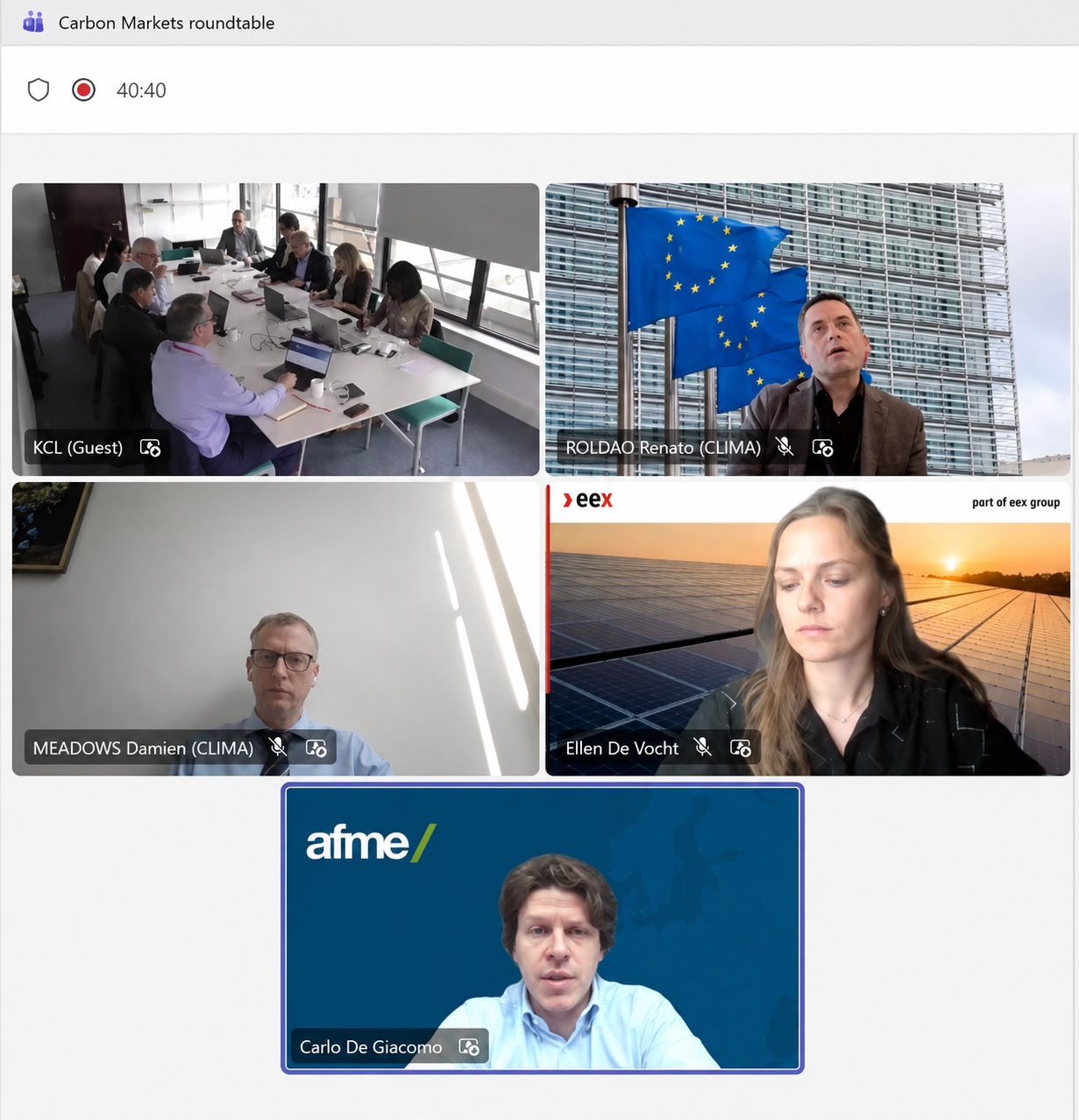
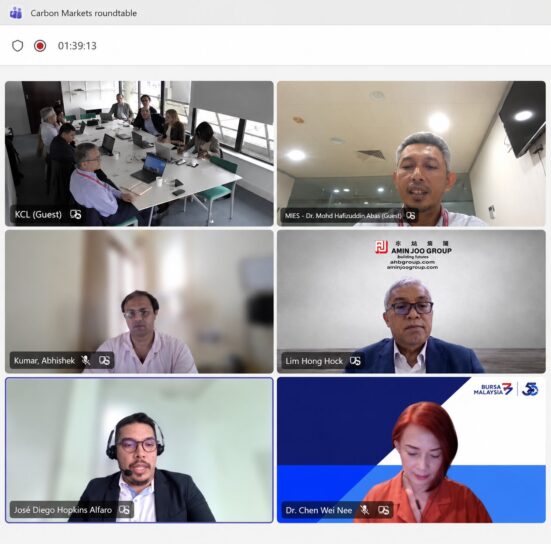
Held in hybrid format, with participants joining in person in London and online from Brussels and Malaysia, the roundtable convened 72 participants from across the public and private sectors. Government representation spanned five ministries — NRES, Ministry of Finance (MoF), Ministry of Investment, Trade and Industry (MITI), Ministry of Energy Transition and Water Transformation (PETRA), and Ministry of Transportation (MOT) — alongside key agencies and statutory bodies, including Malaysia Petroleum Resources Corporation (MPRC), Malaysia Petroleum Management, Malaysian Green Technology and Climate Change Corporation (MGTC), Single Buyer, Civil Aviation Authority of Malaysia (CAAM), Malakoff, Sabah Electricity, and Tenaga Nasional Berhad (TNB). Industry participation included PETRONAS, Press Metal, Alliance Steel, Hiap Teck, Cenergi SEA, FMM, and the Malaysia Steel Institute, with additional representation from the Malaysia Carbon Market Association (MCMA) and the Delegation of the European Union (EU) to Malaysia. Approximately 40% of participants were women, reflecting a strong degree of gender inclusivity across the roundtable.
The session was deliberately structured to move beyond general awareness of the Emissions Trading System (ETS) and bring practical lessons from established carbon markets directly into dialogue with Malaysia’s policy, regulatory, industry, and market-development priorities.
The speaker sequence was designed to reflect the full architecture of a functioning ETS: United Kingdom (UK) ETS / Department for Energy Security and Net Zero (DESNZ) to anchor operational lessons from a live scheme; Directorate-General for Climate Action (DG CLIMA) / European Commission to bring the EU ETS design, implementation, and international policy dimension; European Energy Exchange (EEX) to provide the market-infrastructure perspective, including auctions, liquidity, and exchange-based market functioning; Energy UK to bring the industry and competitiveness lens; and Associate for Financial Markets in Europe (AFME) to add the capital-markets and financial-intermediation perspective. This international sequence was then followed by a dedicated Malaysia response from NRES, Bursa Malaysia, industry, and advisory stakeholders, allowing the discussion to connect global lessons directly to Malaysia’s own Domestic ETS (DETS) design and implementation context.
The roundtable convened a strong line-up of international speakers, including Seamus Gallagher, Deputy Director (Energy Security) and Head of UK ETS Operations at the DESNZ; Renato Roldao and Damien Meadows from the DG CLIMA, European Commission; Ellen De Vocht, Head of EU Representation at EEX; Adam Berman, Director of Policy and Advocacy, Energy UK; and Carlo De Giacomo, Director of Commodities at AFME.
Malaysian speakers included Kumar Abhishek from KPMG Malaysia, Dr. Wei-nee Chen from Bursa Malaysia, Dr. Mohd Hafdzuan Adzmi from NRES, Lim Hong Hock from the Malaysia Iron and Steel Industry Federation (MISIF), and Diego Hopkins from PETRONAS.
The roundtable was structured as a single, focused session with two connected parts. The first, “ETS Lessons from the Regulator and Regulated Entity Perspective,” brought together international regulators and market participants to share operational perspectives on the EU ETS and the UK ETS. Discussions covered how these systems are designed, governed, and how they function in practice. Key themes included regulated-entity readiness, the role of strong policy frameworks in building market confidence and investment signals, the capital markets dimension of ETS, including revenue use, bank intermediation, and liquidity, and implications for sectors exposed to the Carbon Border Adjustment Mechanism (CBAM). The second part, Malaysia’s Response and Moderated Discussion, featured reflections from Malaysian representatives across government, the financial sector, and regulated industries. A moderated discussion explored the direct implications for Malaysia’s DETS design and implementation, drawing on the international lessons shared.
Discussions throughout highlighted that advancing Malaysia’s DETS readiness requires not only technical design work, but also a clear understanding of how established carbon markets operate in practice. Themes of particular relevance included market confidence and investment signals, the financial and capital markets dimensions of ETS, CBAM exposure and trade implications for Malaysia’s export-oriented economy, regulated-entity readiness from Measurement, Reporting, and Verification (MRV) systems to internal carbon pricing, and the need for strong policy coordination and institutional readiness across regulatory bodies, the finance ministry, industry, and market operators.
The intended outcome of the roundtable will be a concise policy report distilling the international lessons discussed and translating them into practical considerations and recommendations for Malaysia’s DETS. The report will outline the main discussion themes and a focused set of policy recommendations tailored to Malaysia’s context.
The roundtable follows the second stakeholder engagement workshop on Malaysia’s DETS, held on 8 April 2026 at Marriott Hotel Putrajaya, and reflects the continued commitment of the UK PACT-supported consortium to building an evidence base for the design and operationalisation of Malaysia’s future DETS policy framework.
