

📝 Summary
The LSP2026 Online Workshop encouraged participants to turn RM30 ideas into RM500 community action, focusing on social innovation and community engagement. Two projects were selected to receive RM500 funding, aiming to address issues such as online scams and sustainable cement crafting. The workshop emphasized adaptability, practical problem-solving, and community engagement in responding to complex challenges.
JOHOR BAHRU, Sep 25 – The LSP2026 Online Workshop, “Beyond the Classroom: Bridging Education, Research & Social Innovation for Impact,” led by Assoc. Prof. Dr. Siti Fatimah Zaharah Mohamad Fuzi of Universiti Tun Hussein Onn Malaysia (UTHM), encouraged participants to explore how education and research can move beyond academic settings to create meaningful and measurable community impact.
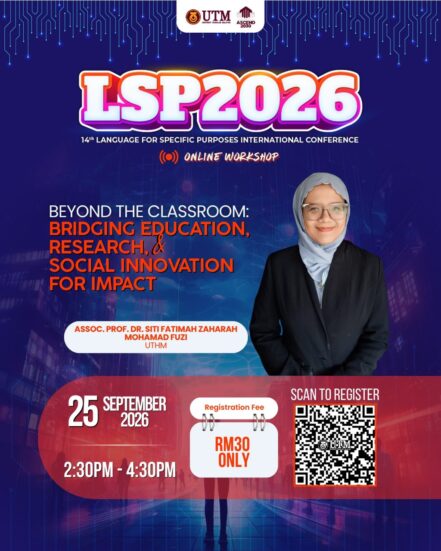
Held as part of the 14th Language for Specific Purposes International Conference (LSP2026), the workshop challenged participants to consider a practical scenario: “You have RM500. You have 30 days. You must improve one thing in a community. What would you do?”
Throughout the session, participants were introduced to practical approaches for designing community engagement and social innovation projects. A key message was to begin by identifying what needs to change, rather than simply deciding what activity to conduct. As Assoc. Prof. Dr. Siti Fatimah emphasised during the session, “Don’t start with what you want to do. Start with what needs to change.”
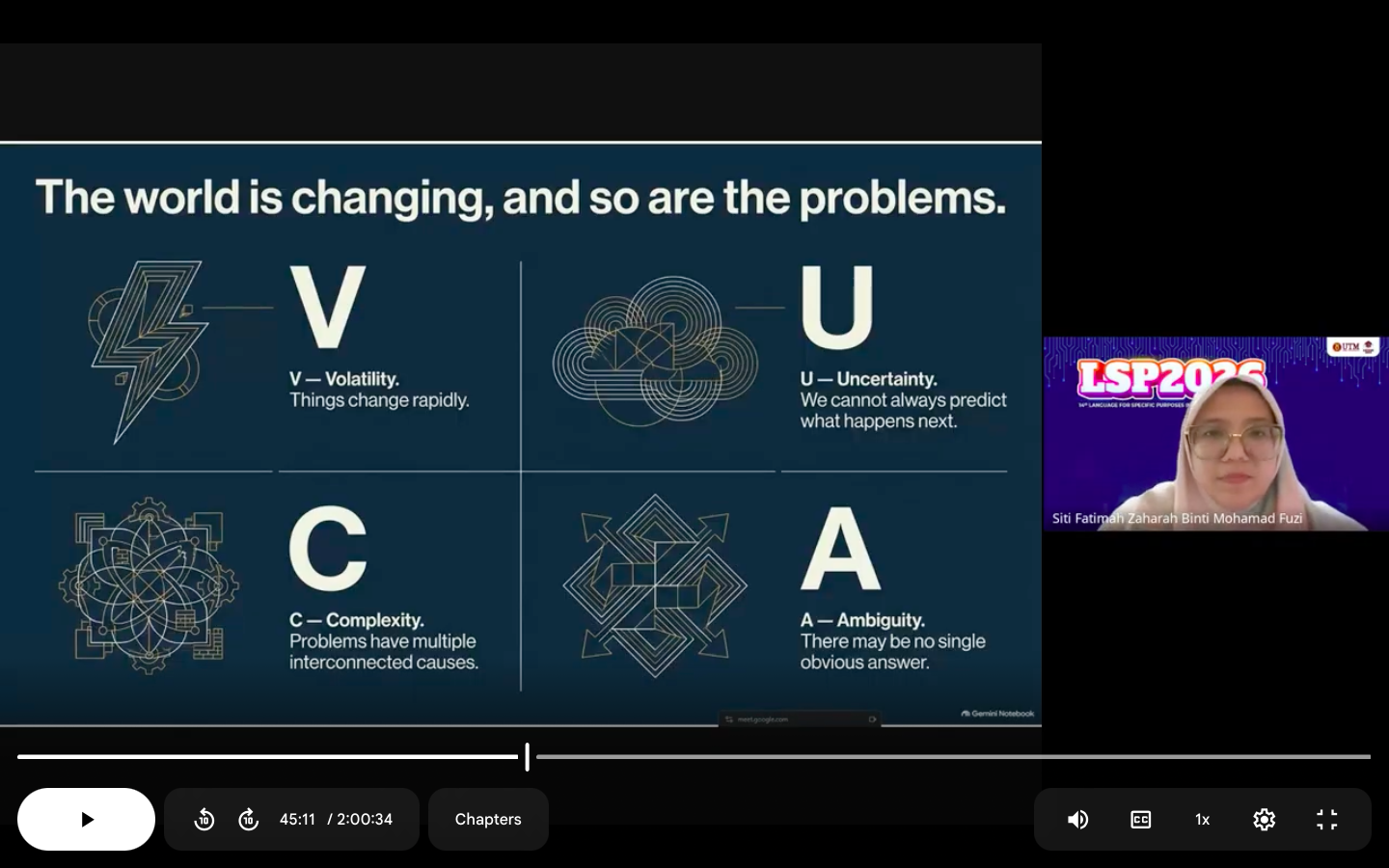
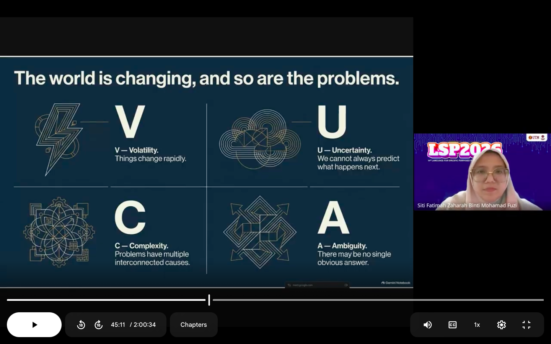
The session further explored social innovation within a VUCA environment—Volatility, Uncertainty, Complexity and Ambiguity—highlighting the importance of adaptable, practical and community-centred responses to increasingly complex challenges. Examples from previous community initiatives were also shared to demonstrate how academic knowledge can be translated into real-world impact while strengthening communication, innovation and community-engagement skills.
As an extension of the workshop, participants were invited to submit a written proposal for a small-scale social innovation or community engagement project. With a registration fee of only RM30, participants had the opportunity to compete for project funding to turn their ideas into action.
Following the evaluation of the submitted proposals, two projects were selected, with each receiving RM500 to support its implementation. Read Before You React: Digital Language Literacy for Senior Citizens, led by MLCDC ODL student Pavethere Devan Kanesan, Universiti Teknologi Malaysia, aims to help senior citizens recognise manipulative language commonly used in online scams, including urgency, fear, authority, reward and pressure. Through Traffic Light activities, real message examples and role-play, participants will learn to stop, interpret and verify suspicious messages before responding.
Empowering Communities Through Sustainable Cement Crafting (ECOSTONE 2.0), led by Dr. Nur Liyana Mohd Kamal of Universiti Tenaga Nasional (UNITEN), introduces communities to Simenfero technology and the use of recycled waste materials as alternatives to virgin sand in producing useful landscape products. The project combines sustainability, community skills and potential green income generation.
Both selected proposals reflect the workshop’s emphasis on responding to a VUCA environment through adaptability, practical problem-solving, community engagement and sustainable action. Their proposals demonstrate how education and research can be translated into practical social innovation, with RM500 in implementation funding providing an opportunity to move from ideas on paper to meaningful action within their communities.
By: Dr. Nurhidayah Mohd Shariff and Nur ‘Ain Mohd Shahroom, Faculty of Social Science and Humanities, UTM
