
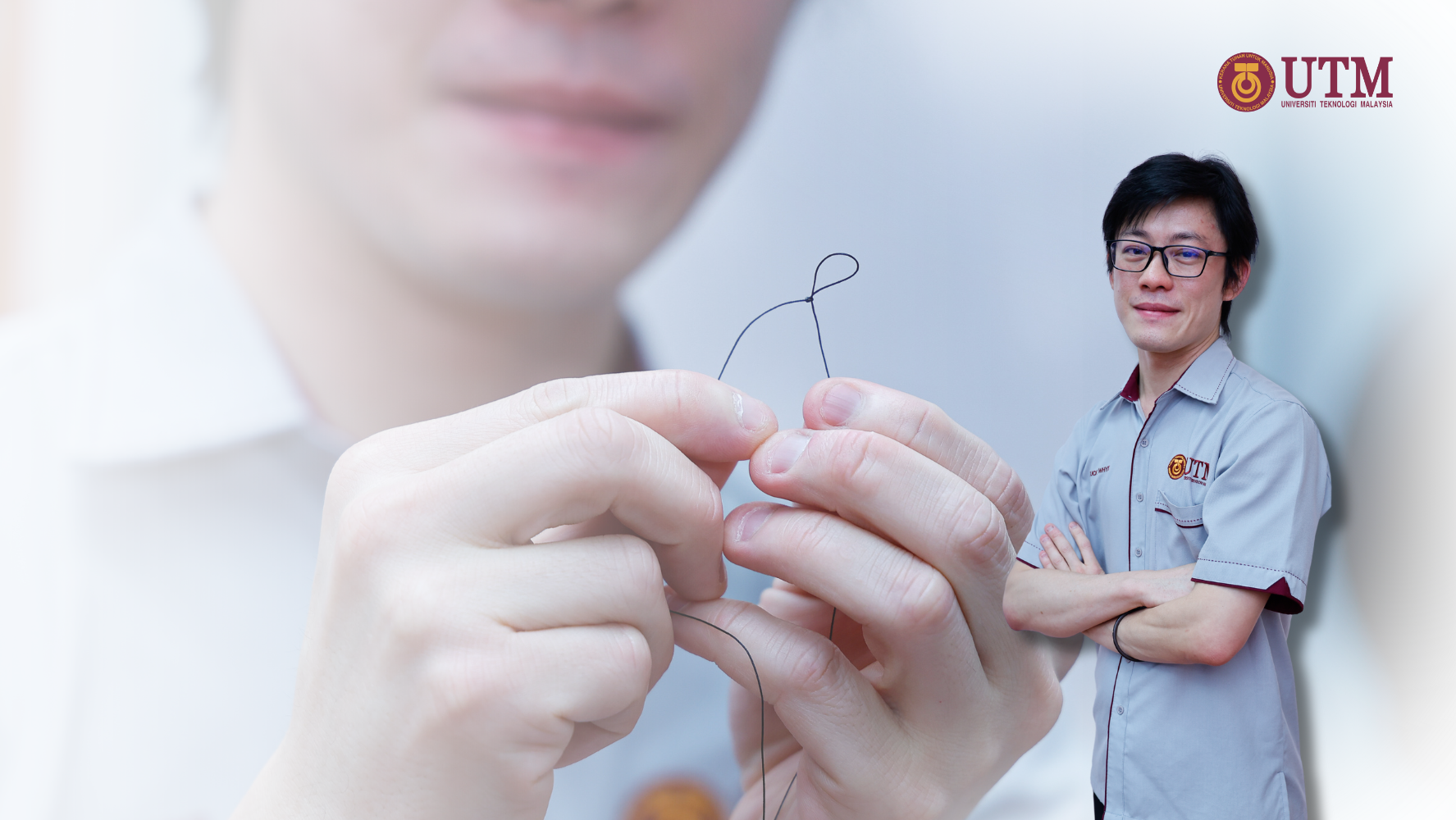

What if one of the simplest mechanical tools in human history could offer a solution to one of modern surgery’s most persistent challenges?
That question underpins a study co-authored by Dr. Tuck-Whye Wong, an academic and researcher from the Department of Biomedical Engineering and Health Sciences, Faculty of Electrical Engineering, Universiti Teknologi Malaysia. Published online on 10 December 2025 in the highly prestigious Nature journal, the paper titled A Simple Slipknot for Precise Force Control presents a new approach to improving surgical safety and consistency by harnessing the intrinsic mechanics of slipknots.
Surgical suturing is a routine but critical component of many medical procedures. Yet achieving the correct knot tension remains highly dependent on experience and visual judgement. Knots tied too tightly risk tissue damage and restricted blood flow, while loose knots may lead to leakage or failed wound closure. Moreover, existing electronic force-sensing solutions add cost, complexity, and reliance on power supply, limiting their applicability in many clinical settings.
Rather than introducing additional technology, the research team asked a more fundamental question. Can the knot itself be designed to regulate force?
Through systematic mechanical testing, imaging, and computational modelling, the study demonstrates that slipknots can be engineered to release at a predictable force threshold. This discovery led to the development of “sliputures,” a suturing approach in which force control is embedded directly into the knot. The result is a sensor-free, power-independent method capable of delivering consistent knot tension across users with different levels of experience.
For Dr Wong, the work also reflects the importance of multidisciplinary research in addressing complex real-world problems. The study sits at the intersection of mechanical engineering, robotics, and surgical practice, showing how insights from one discipline can unlock progress in another. He notes that such cross-disciplinary spaces are often where unexpected connections emerge and meaningful innovation takes shape.
“This work could only happen because we were willing to cross disciplinary boundaries,” Dr Wong said. “When engineers, roboticists, and clinicians engage deeply with one another, you create room not just for planned outcomes, but for discoveries that emerge through curiosity and experimentation.”
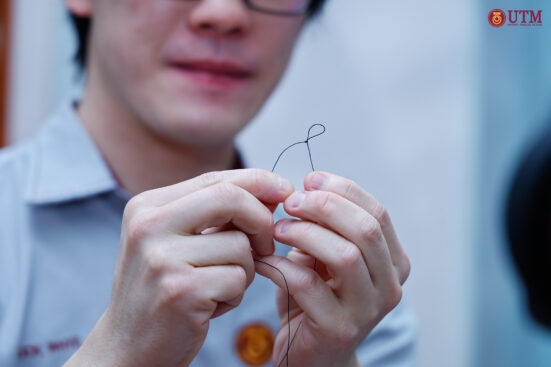
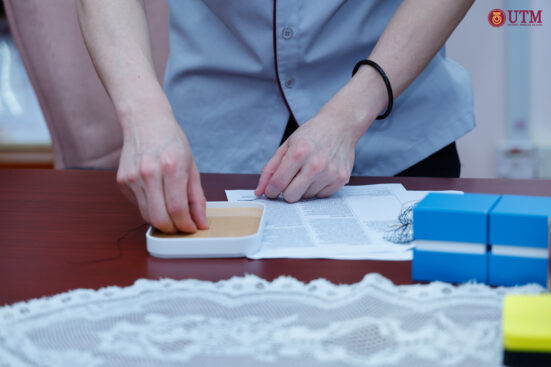
The work was conducted through a close international collaboration. Dr Tuck-Whye Wong is at Universiti Teknologi Malaysia, Johor Bahru, Malaysia, and his co-author, Dr. Tiefeng Li, is at Zhejiang University in Hangzhou, China. Their partnership spans nearly a decade and reflects a sustained research relationship built on continuity rather than convenience.
“Over the past decade, we have built a working relationship grounded in trust and openness,” Dr Wong said. “That long-term collaboration with Zhejiang University allows us to pursue fundamental ideas and test them rigorously across different systems and environments.”
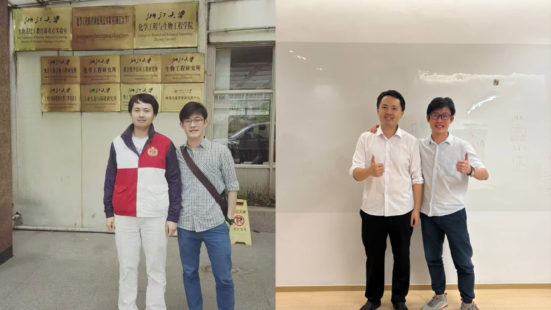
Beyond joint publications, this collaboration has created tangible benefits for research training and talent development. Through the UTM–Zhejiang partnership, Dr Wong’s students have gained access to international research placements and internships, particularly in advanced engineering and robotics laboratories. These opportunities provide early exposure to different research cultures, experimental approaches, and performance expectations, strengthening students’ confidence and research capability.
“One of the most meaningful outcomes of this collaboration is what it has done for our students,” Dr Wong added. “Spending time in Zhejiang University’s research laboratories exposes them to different research cultures and ways of thinking, and it helps them develop confidence early in their careers as researchers.”
The impact of the work is evident in the study’s experimental findings. In surgical trials, students using sliputures for the first time were able to tie knots with force precision comparable to that of experienced surgeons, significantly reducing variability. The same principle was successfully demonstrated in a tendon-driven robotic system, highlighting potential applications in manual surgery, robotic-assisted procedures, and healthcare environments where access to advanced equipment is limited.
For the research community, the study offers a broader insight into innovation. Progress does not always require increasing technological complexity. In this case, re-examining a simple mechanical structure through rigorous, multidisciplinary analysis opened new possibilities across surgery, robotics, and training.
Research published in Nature is widely regarded as highly influential, often shaping future directions across disciplines. Dr Wong’s role as a co-author reflects the contribution of Malaysian researchers to globally significant scientific work and highlights UTM’s role as an enabling research institution and one that sustains long-term international collaboration, supports multidisciplinary inquiry, and creates space for meaningful research study. Guided by its commitment to Innovating Sustainable Solutions, these conditions allow fundamental scientific insights to be translated into practical, real-world impact.
