
JOHOR BAHRU, 15 Dec — Universiti Teknologi Malaysia (UTM has emerged as a key institutional driver of climate action through a structured community-based e-waste recycling programme implemented between 2023 and 2025. Anchored in the Global–University–Community–Industry (GUCI) framework, the initiative demonstrates how a research university can translate academic leadership, grant-driven innovation, and multi-stakeholder collaboration into measurable environmental and societal impact.
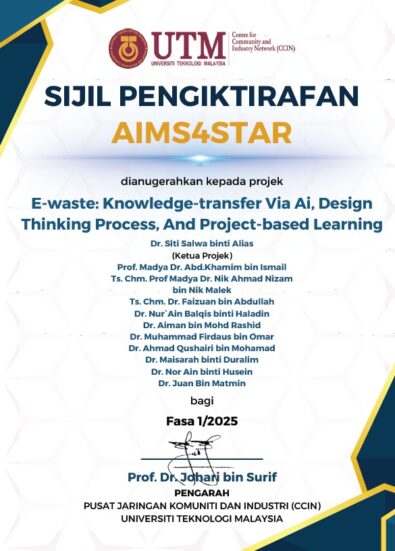
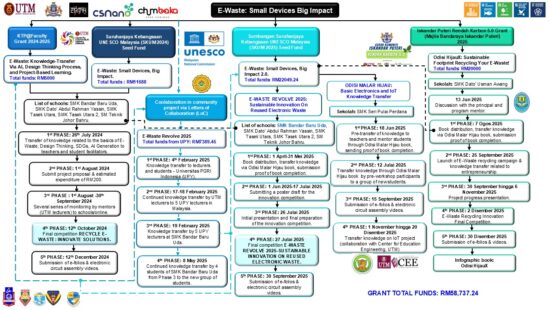
As the programme lead and coordinating institution, UTM provided the strategic direction, governance framework, and scientific rigour underpinning the initiative. The programme was developed through competitively awarded grants, including UTM@Faculty Grants under the Centre for Community and Industry Network (CCIN), Malaysian National Commission for UNESCO (MNCU) Seed Funds, the Iskandar Puteri Low Carbon (IPRK) 5.0 Grant by the Iskandar Puteri City Council (MBIP), alongside sustainability-focused innovation funding. These funding streams enabled UTM to implement a phased and scalable model integrating knowledge transfer, community engagement, innovation development, and impact evaluation.
UTM’s leadership was further reflected in its emphasis on transparent, auditable, and data-driven sustainability reporting. The University established standardised data-collection protocols, relying solely on officially recorded weights for environmental calculations and avoiding extrapolation where item-level data were unavailable. This methodological discipline ensures that reported outcomes are credible, verifiable, and suitable for institutional reporting, Environmental, Social and Governance (ESG) disclosures, and grant accountability.
The industry component of the GUCI ecosystem was strengthened through a strategic collaboration with ERTH, a licensed e-waste recycler. While ERTH contributed certified expertise in collection, dismantling, and recycling processes, UTM remained the central integrator by aligning industrial practices with academic standards, sustainability objectives, and regulatory requirements. This partnership enabled the responsible handling of diverse e-waste streams while reinforcing UTM’s role as the programme anchor.
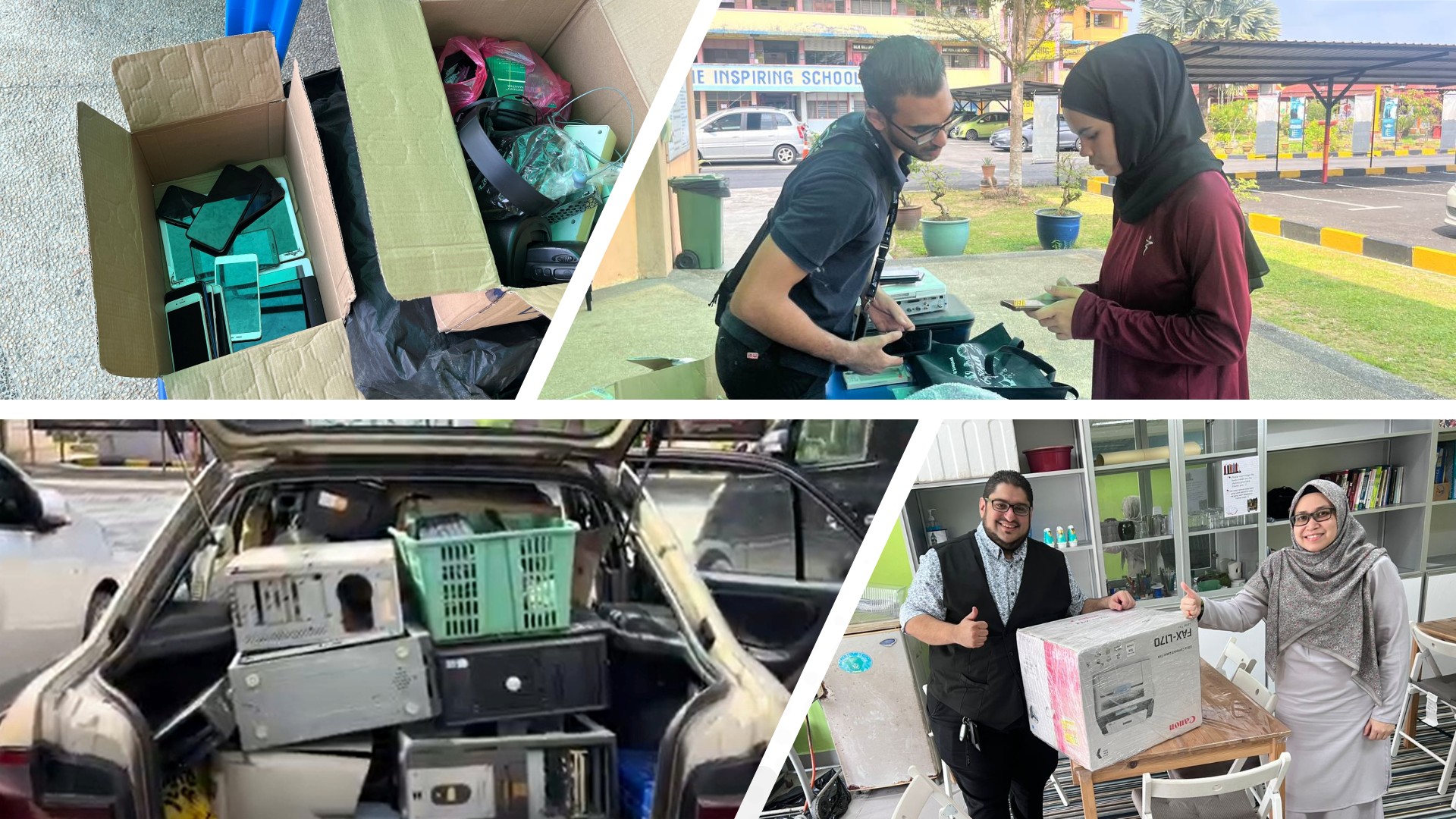
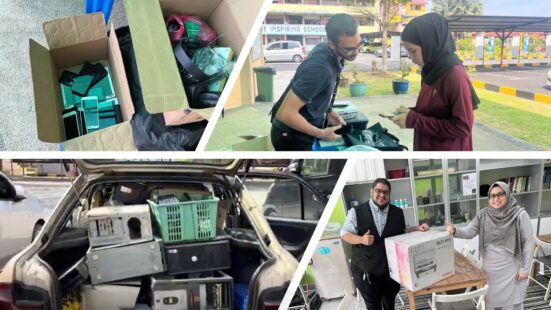
Community engagement formed a core pillar of the initiative. UTM actively mobilised secondary schools, public libraries, and community institutions as co-creators of impact rather than passive participants. Schools such as Sekolah Menengah Kebangsaan (SMK) Pulai Perdana, SMK Bandar Baru Uda, and SMK Dato’ Usman Awang, alongside public spaces including Perpustakaan Sultan Ismail, functioned as living laboratories for sustainability education. Through hands-on participation, students and community members were exposed to circular economy principles, responsible consumption, and environmental stewardship.
Across ten verified community collection events, the UTM-led programme collected 2,777.10 kg (approximately 2.78 tonnes) of e-waste, including laptops, mobile phones, printers, monitors, CPUs, and mixed electronic waste. All activities were supported by licensed recycling partners, ensuring regulatory compliance and responsible material recovery. Based on verified recycling certificates and conservative life-cycle assessment assumptions, the initiative achieved an estimated reduction of 4,165.65 kg of carbon dioxide equivalent (CO₂-eq) emissions — equivalent to the annual carbon absorption capacity of 198 mature trees.
Beyond environmental outcomes, the programme generated RM2,522.10 in community redemption value, demonstrating that sustainability initiatives can also deliver tangible socio-economic benefits. A total of 587 individual e-waste itemswere responsibly recycled, reflecting strong community participation and increasing awareness of sustainable disposal practices.
Aligned with global sustainability priorities, the programme supports the United Nations Sustainable Development Goals (SDGs), particularly SDG 12 (Responsible Consumption and Production) and SDG 13 (Climate Action). The use of internationally recognised indicators such as CO₂-eq and tree-equivalent metrics positions the initiative within global sustainability and low-carbon reporting frameworks.
Overall, the initiative reflects UTM’s broader institutional strategy of positioning the University as a system leader within the GUCI ecosystem. Through phased implementation — from foundational e-waste literacy and design thinking to innovation challenges and sustainability-driven knowledge transfer — UTM has demonstrated how universities can orchestrate long-term, impact-oriented sustainability programmes.
By converting grant support into structured action and verifiable outcomes, UTM has reaffirmed its role as a national and regional leader in climate-responsive higher education, setting a benchmark for future GUCI-driven sustainability initiatives.



Prepared by: Ts. Dr. Siti Salwa Alias and Dr. Maisarah Duralim, Faculty of Science UTM
