


📝 Summary
Artificial Intelligence (AI) has evolved beyond chatbots and text generation, with robotics emerging as a key area of focus. Robotics combines AI with physical systems, enabling machines to interact with the environment in a more sophisticated way. Studying robotics can prepare individuals for technological applications readiness in the near future and provide a competitive advantage in the job market.
Artificial Intelligence (AI), once considered a futuristic concept, has become increasingly present across numerous industries. From changing the way we work and think to creating new ways for humans to interact with machines, the impact of AI can no longer be overstated. Many students will likely have encountered AI through chatbots such as ChatGPT.
However, AI applications have extended beyond text generation, image creation and question-answering. With the emergence of embodied AI, intelligent systems such as robots can interact with their surroundings in more sophisticated ways.
So, is robotics going to be the future of AI? Will studying robotics today help prepare us for technological applications in the near future?
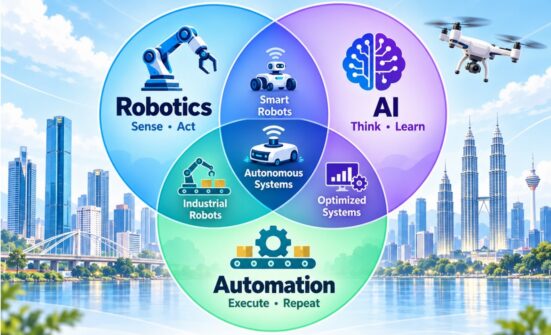
To begin answering these questions, it is essential to understand the differences among robotics, AI and automation. Robotics refers to the design, construction and programming of mechanical devices known as “robots” that can perform various physical tasks.
AI, on the other hand, focuses on developing computer systems that can analyse data, identify patterns and make decisions based on their analysis. Automation differs from both in its purpose: it enables work processes to take place with minimal or no manual human intervention, often by using predetermined sequences of operations.
For example, a traditional robot in a factory might repeatedly perform the same task according to pre-programmed instructions. An AI-powered robot, however, may use cameras, sensors and machine learning to identify objects, detect obstacles and adjust its movements.
When these capabilities are integrated with automation, they can support a more autonomous system. This demonstrates how AI can move beyond computer screens and interact with the physical world. Understanding how these technologies work together is becoming increasingly relevant, especially for those who wish to pursue careers in technology and engineering.
By learning robotics, students can understand how software and hardware work together to solve real-world problems.
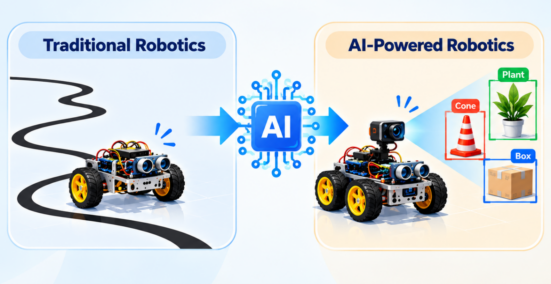
While robotics has traditionally involved designing and building robots using mathematics, physics and engineering, AI-applied robotics focuses on developing intelligent robotic systems. Integrating an AI model into an existing robotic system allows users to explore how a robot can recognise objects, interpret its surroundings and make decisions based on data collected by sensors.
To create an intelligent robotic system, learners need to understand how an AI model works, how different sensors collect data and how these components interact with the robotic control system. Integrating AI into a robot is not always straightforward.
Developers need to identify suitable AI models for their projects, analyse sensor data, test the robot’s performance and diagnose problems caused by unexpected behaviour. Through this process, they can develop critical-thinking and problem-solving skills while gaining a better understanding of the limitations of applying AI in practical settings.
In addition to developing robotics-related skills, knowledge of robotics may also provide a competitive advantage in the job market as AI and automation become more prevalent across industries.
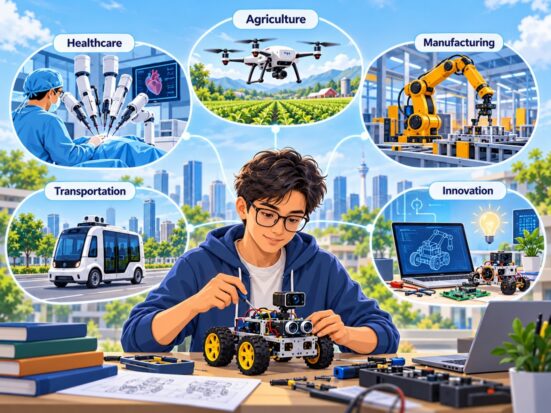
Robotics-related skills are relevant to multiple employment sectors, including manufacturing, agriculture, engineering, transportation and healthcare. In healthcare, for example, robotic systems can assist doctors during surgical procedures by supporting precise movements.
Automated farming equipment can help farmers monitor crops and carry out physical tasks more efficiently. Manufacturing companies also use industrial robots to improve efficiency and reduce the risk of injury or fatigue associated with physically demanding and hazardous work.
These examples illustrate how robotics can support people in different working environments, although the specific benefits depend on the task and the system being used.
Learning about robotics does not necessarily mean that every student must become an engineer. Students pursuing careers in business, design or entrepreneurship can also benefit from understanding how intelligent machines function.
This knowledge may help them recognise potential applications, develop new products and collaborate more effectively with technical professionals. For future entrepreneurs, an understanding of robotics could help turn an idea into a practical solution by making it easier to identify what technology can—and cannot—do.
Introducing robotics education into university curricula can therefore encourage students to become active creators of technology rather than merely consumers of it.
It is also important to recognise that adding AI does not automatically make every robot more effective. A system must be designed around the task, tested in the conditions in which it will operate and assessed for reliability and safety.
This is one reason practical learning matters: students can move beyond understanding concepts in theory and examine how design choices affect a robot’s behaviour in real environments.
Ultimately, “The future of AI depends not only on smarter machines, but also on individuals capable of developing them through education and imagination.”
Written by: Dr. Mas Omar Mas Rosemal Hakim, Senior Lecturer, Faculty of Artificial Intelligence (FAI), Universiti Teknologi Malaysia (UTM)
