


📝 Summary
Universiti Teknologi Malaysia (UTM) aims to become a Future-Ready Green Talent University for the Nation, preparing students for a lifetime of change and a rapidly shifting job market. The university will focus on developing graduates with strong technical foundations, the ability to work with people, and a deep understanding of sustainability and the environment.
A Hari Akademia reflection on future-ready graduates, green talent and Malaysia’s changing economy
Every year, Hari Akademia on 5 October gives us an opportunity to acknowledge the contribution of academics to higher education and national development. It should also give us time to reflect.
For those of us in universities, one question deserves particular attention today: what kind of graduate will Malaysia need ten or twenty years from now?
It is tempting to answer this question by looking at today’s vacancies, today’s technologies or the skills employers are asking for now. Yet a student entering university in 2026 may still be professionally active in the 2060s. During that working life, technologies will change several times. Some jobs will disappear, others will emerge, and many familiar professions will be carried out very differently.
The World Economic Forum’s Future of Jobs Report 2025 estimates that changes in technology, the green transition, demographic trends and economic conditions could affect 22 per cent of today’s formal jobs globally by 2030. Employers surveyed for the report also expect close to 40 per cent of skills used in existing jobs to change.
Malaysia is already experiencing this shift. TalentCorp’s study of artificial intelligence (AI), digitalisation and the green economy examined 949 job roles across ten important sectors. About 620,000 employees in those sectors are expected to be significantly affected by these changes, while 60 emerging job roles were identified.
These numbers matter, but the larger message matters more.
“Universities cannot prepare students only for their first job. We must prepare them for a lifetime of change”
That is where the idea of Universiti Teknologi Malaysia (UTM) as a Future-Ready Green Talent University for the Nation becomes relevant.
Green talent is not limited to green jobs
When we hear the term “green talent”, we may imagine a renewable-energy engineer, an environmental scientist, or someone working in conservation.
That interpretation is too narrow.
Consider a civil engineer designing drainage for a city facing heavier rainfall. The engineer still needs strong knowledge of hydraulics and structural design, but must now also consider climate risk, land-use change, construction materials, energy use and long-term maintenance.
Consider an electrical engineer working with renewable energy, battery storage, or an increasingly digital power grid. Or an architect designing buildings that must remain comfortable while consuming less energy and water.
A computer scientist may be asked to develop an artificial-intelligence system that reduces energy consumption in a factory. A chemist may work on recovering useful materials from waste. An accountant may increasingly encounter carbon information and sustainability reporting. A business graduate may have to decide whether a supply chain remains reliable when drought, flooding or changes in energy prices affect suppliers.
None of these people needs to abandon his or her profession to become “green”.
Instead, the profession itself is changing.
For that reason, green talent should not be treated as a small specialist group. It is better understood as people who are good at their profession and are also able to make sound decisions about resources, technology, the environment and society.
Malaysia’s National Energy Transition Roadmap (NETR) recognises this need. It calls for a green-skills framework, better planning of future workforce needs, reskilling and upskilling programmes, and stronger partnerships between universities and industry.
The New Industrial Master Plan (NIMP) 2030 tells a similar story from an industrial perspective. Malaysia wants higher-value manufacturing, wider use of digital technology and AI, and at the same time a manufacturing sector that becomes cleaner and more resource-efficient.
So our economic transition is also a people transition.
Factories can be automated. Solar farms can be built. Data centres can be constructed. New rail systems, water infrastructure and advanced manufacturing facilities can be developed.
But technology does not operate itself.
Behind every successful transition are people who can design, operate, question, repair, improve and govern that technology.
This is why investment in green technology without investment in people will eventually reach a limit.
What should a UTM graduate carry into the future?
For UTM, the answer should begin with something quite fundamental.
A future-ready graduate must first be good at what he or she is trained to do.
An engineer needs sound engineering fundamentals. A scientist needs scientific discipline. A computer scientist must understand computing. A manager must understand organisations and decision-making.
Sustainability should strengthen professional competence, not replace it.
But today’s graduates will need more than disciplinary knowledge.
They must be comfortable working with data and digital technologies, including AI. At the same time, they should know when technology gives an unreliable answer. The ability to question an output may become as important as the ability to generate one.
They also need to understand the physical world around them.
Energy has a cost. Water is finite. Materials come from somewhere. Waste goes somewhere. Infrastructure operates within landscapes and communities. Climate conditions affect both engineering design and business decisions.
These are simple observations, but they change the way a professional sees a problem.
A future-ready graduate should also know how to work with people.
A technically elegant solution can fail if the community rejects it, if it is too expensive to maintain, if regulations are ignored or if the person proposing it cannot explain why it matters.
Communication, teamwork, integrity, empathy and professional judgement therefore remain important even in an age of AI. Perhaps they become more important precisely because technology is becoming more powerful.
The composition of the future graduate is therefore not a competition between technical skills and human qualities.
Malaysia needs both.
We need graduates with strong technical foundations who can use new technology, understand environmental consequences, work across disciplines, communicate clearly and continue learning when circumstances change.
This is the difference between being merely ready for a job and being ready for the future.
A university cannot teach the future from the classroom alone
Some of the most valuable learning takes place when students encounter a real problem that refuses to behave like an examination question.
A river does not present all its data neatly. A community may have different priorities from an engineer. A factory has budget constraints. A drainage system is connected to land development upstream. An energy-saving proposal has to work with actual buildings and actual users.
Students need to encounter these realities before graduation.
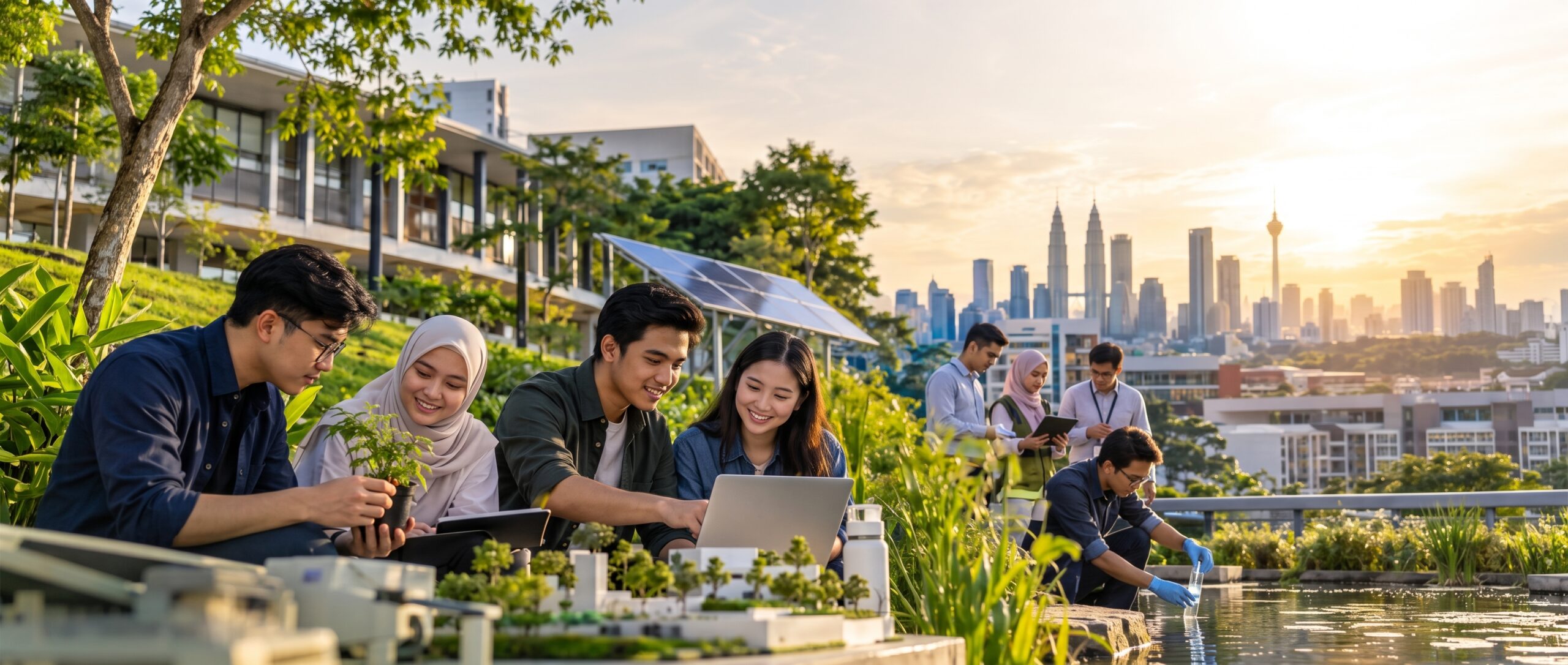
UTM has an advantage here because the university itself can become part of the learning process.
A campus has buildings, laboratories, roads, vehicles, food outlets, electricity consumption, water systems, waste, trees, lakes and thousands of people making daily choices.
Why should these only be operational matters?
They can also become learning opportunities.
Students can study electricity use in a building, investigate water losses, analyse mobility patterns, design waste-reduction measures or monitor biodiversity. They can propose solutions, test them and observe whether those solutions work.
A sustainability problem on campus can therefore become an engineering problem, a computing project, a behavioural study, a management exercise and even a business opportunity.
This is education at its most useful: knowledge being tested against reality.
UTM ASCEND 2030 provides an important institutional foundation for this direction. Its four areas of distinctive emphasis include Global Talent, Sustainability, Humanity and Well-being, alongside excellence in research and innovation. The Global Talent pillar specifically refers to developing learners into future-ready professionals with global competencies.
The opportunity is therefore not to create sustainability as another isolated programme. It is to bring these ambitions together through the experience of our students.
From UTM to ASEAN through TUNE Erasmus+
UTM’s role as coordinator of the TUNE Erasmus+ Capacity Building in Higher Education (CBHE) project offers a practical opportunity to test this approach beyond our own campus.
Traditional Music Undergraduate Network in Europe (TUNE) was designed to strengthen green-jobs education in universities, improve staff capability, update learning content, engage employers and give students greater exposure to practical experience and sustainable careers.
Its value lies not in introducing another label into higher education, but in connecting activities that universities sometimes carry out separately.
What does industry actually need? What should students learn? Are educators prepared to teach it? Can students practise it? Can employers participate? Can shorter learning programmes help graduates and working professionals acquire new skills without returning for another full degree?
These are practical questions.
At UTM, the One Stop Centre for Green Jobs Education is being developed around this connection between learning pathways, industry involvement, micro-credentials, internships, living laboratories and employability.
This is important for another reason.
Malaysia’s green transition will not stop at our national border.
Companies operate across the Association of Southeast Asian Nations (ASEAN). Supply chains cross countries. Environmental problems such as haze, climate change, marine pollution and river management do not respect political boundaries. Students will increasingly work in regional and international settings.
Future-ready talent therefore needs both local understanding and international exposure.
Through projects such as TUNE, UTM can contribute to a wider ASEAN conversation about how universities prepare young people for economies that must grow while using energy, water and natural resources more responsibly.
A degree can no longer be the end of learning
There is another reality universities must address.
For many generations, higher education followed a fairly predictable route. A young person entered university, completed a degree, graduated and moved into employment.
That pathway remains important, but it can no longer be the only model.
A person graduating today may change jobs several times and may even change profession. New software will appear. Regulations will change. Industries will adopt new technologies. Employers will expect capabilities that did not exist when that person first entered university.
This means universities must maintain a relationship with learners long after convocation.
Malaysia’s Higher Education Blueprint (RPTM) 2026–2035 recognises this direction. One of its major shifts focuses on flexible education and lifelong learning, including micro-credentials, industry certification and more flexible ways for people to continue learning. Another shift focuses on planetary health and sustainability, with plans to strengthen these elements in higher-education curricula and campus practice.
For UTM, this raises an interesting possibility.
Our responsibility need not end when a student receives a degree scroll.
The university can become a place to which graduates return throughout their careers—to learn about a new technology, gain a specific competence, prepare for a career transition, or understand a new challenge facing their industry.
In that model, the university is not simply a place people attend once.
It becomes a lifelong partner in professional growth.
Hari Akademia asks something of academics too
Hari Akademia rightly celebrates lecturers, researchers and scholars who have contributed to higher education and society since the national observance began on 5 October 2019.
But recognition should come with reflection.
If the world our students are entering has changed, our work as academics must change with it.
Teaching cannot be limited to transferring information. Information is now abundant and can be generated in seconds.
Our greater responsibility is to help students distinguish a good argument from a weak one, evidence from assumption, and a convenient answer from a responsible decision.
We should allow students to encounter difficult problems for which there may not be one perfect answer.
We should also remain connected to what happens outside the campus. Industry, government, professional organisations and communities can tell us where new problems are emerging. Academics can then bring research, evidence and critical thinking into those conversations.
This does not reduce the importance of scholarship.
It strengthens its purpose.
The measure of academic contribution will always include publications, discoveries, inventions, patents and graduates. But there is another question worth asking: what changes because that knowledge exists?
Does an industry operate better?
Does a community become safer?
Can a city withstand climate pressures?
Is water managed more wisely?
Can a company reduce waste without losing competitiveness?
Can a graduate make a better decision because we taught him or her how to think rather than simply what to remember?
Those questions bring academia closer to society.
Future-ready talent is a national capability
Malaysia’s ability to navigate the coming decades will depend partly on infrastructure, investment and technology.
But ultimately it will depend on people.
We will need engineers who can build infrastructure for a changing climate. Scientists who can protect water and natural systems. Computing professionals who can use AI responsibly. Entrepreneurs who can turn environmental problems into useful products and services. Managers who understand both productivity and resource efficiency. Educators who can prepare the next generation for problems that we cannot yet fully predict.
Not every graduate will have “green” in his or her job title.
That is not the point.
The ambition should be that graduates leave UTM with a clearer understanding that their professional decisions have consequences—for an organisation, for society and for the environment—and with the competence to make those decisions well.
That, to me, is what a Future-Ready Green Talent University for the Nation should mean.
As we commemorate Hari Akademia, perhaps our most useful question is therefore not how much knowledge a university can produce.
It is what our graduates are able to do with that knowledge when they leave us.
If they can think independently, use technology wisely, solve real problems, care about the consequences of their decisions, and continue learning throughout their lives, then universities will have done more than prepare young people for employment.
“We will have helped prepare Malaysia for its future”
Prepared by: Prof. Ir. Ts. Dr. Mohd Fadhil Md Din, Professor at Universiti Teknologi Malaysia (UTM), EXCO of the UTM Council of Professors, and Project Coordinator of the Erasmus+ CBHE TUNE initiative
