
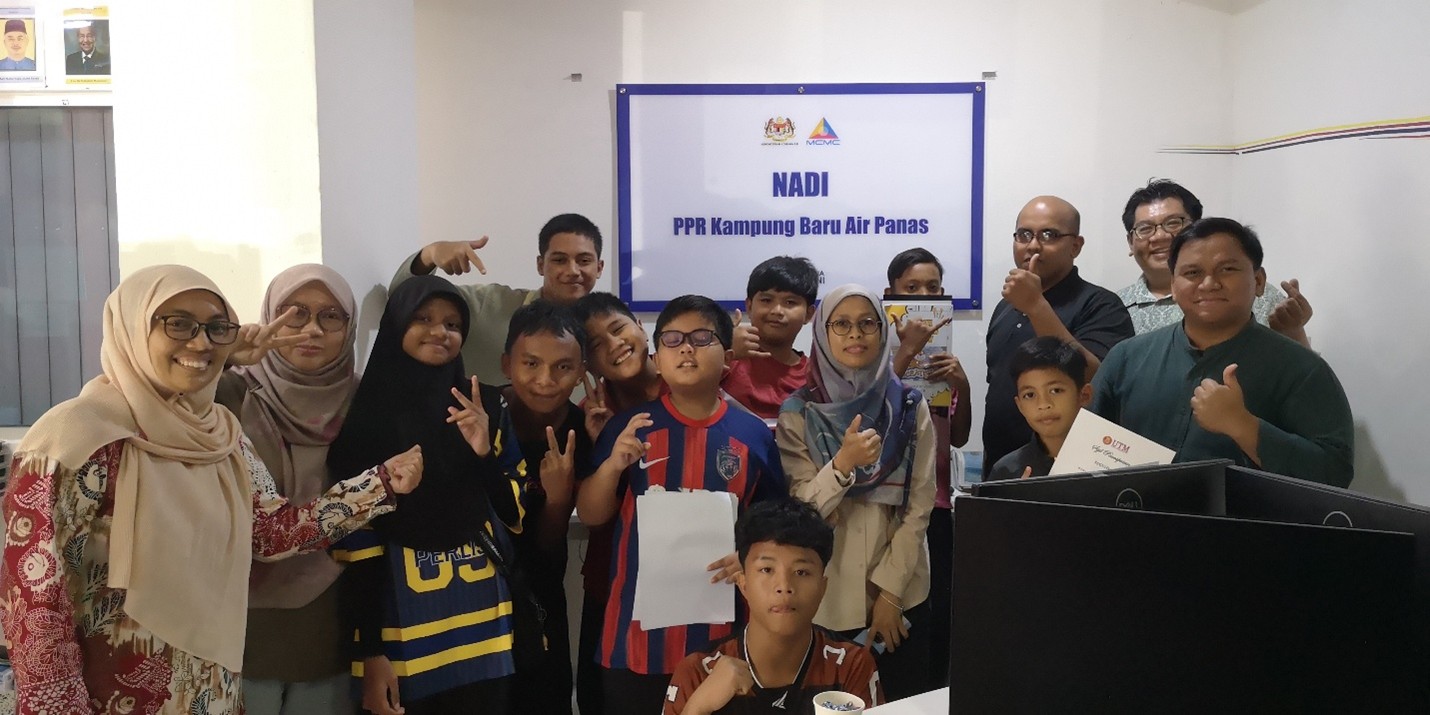
KUALA LUMPUR – There is a moment, familiar to anyone who has spent years in education, when learning reveals itself not through assessment or instruction, but through expression. A child sits before a screen, hesitant, uncertain of what might follow. Then something responds. A figure moves. A sound is heard. The child pauses, leans forward, and smiles, surprised less by the technology than by their own agency.
Such moments were quietly abundant at National Information Dissemination (NADI) People’s Housing Project (PPR) Kampung Baru Air Panas, Kuala Lumpur, during a Scratch workshop conducted as part of Projek GEMPAK. Although the session took place in October, its significance extends well beyond the confines of a single day. The initiative was made possible through the leadership of Dr Nurul Aini Bani and was conducted on-site by Dr Saharudin Ismail, together with colleagues from the Electrophysiology Research Group (EPL) at the Faculty of Artificial Intelligence, Universiti Teknologi Malaysia (UTM).
Projek GEMPAK, led by Dr Nurul Aini Bani under a community research grant, was conceived to bring early exposure to digital thinking into the PPR community. The framework and institutional support were essential, yet the essence of the experience unfolded quietly in a modest computer room, sustained by patience, curiosity, and careful guidance.
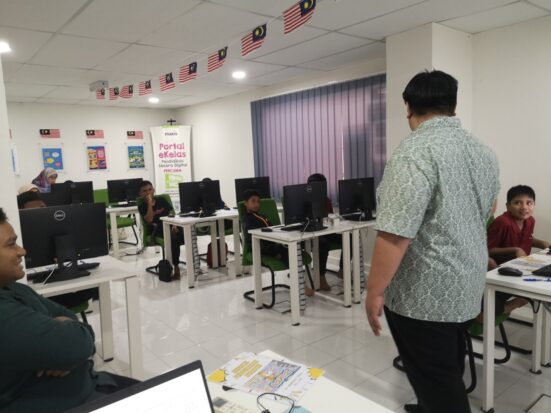
Some children arrived early and waited without comment. Others remained at the threshold, uncertain whether the space was truly theirs. Few had any meaningful encounter with coding before that day. For many, this was the first occasion on which they were invited not merely to operate technology, but to shape it.
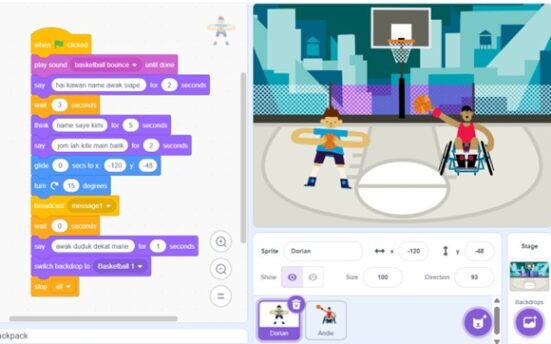
The session began without urgency. Hands hovered above keyboards. Questions were tentative and often prefaced with an apology. Gradually, blocks aligned on the screen. A Sprite responded. A story acknowledged a click. Almost imperceptibly, the atmosphere shifted.
Within the hour, instruction gave way to intention. The children no longer waited to be told what to do; instead, they asked what might be possible. Could the ending be changed? Might another level be added? Could a game become a story? Their engagement was not driven by obligation, but by ownership.
What proved most striking was their concentration. For much of the day, the children remained absorbed, energetic without restlessness, determined without anxiety. They assisted one another, corrected minor errors, and approached mistakes with curiosity rather than frustration. By the end of the session, each participant had produced a working Scratch project shaped by their own decisions.

Scratch mattered precisely because it removed fear. There were no penalties for error, no finality in failure. In its place was a responsive environment that invited experimentation. In learning this, the children grasped something more enduring than syntax. They discovered that technology can answer back, and that they themselves are capable of directing it.
For the educators involved, the experience carried a quiet gravity. Academic life is often measured through outputs, schedules, and expectations. Standing beside a child at the moment they recognise their own capability offers a different calibration of purpose. It restores teaching to its most elemental form.
This experience made no promises of careers or futures. It offered something more restrained and perhaps more honest. An invitation to explore. A moment of confidence. On occasion, that is sufficient to open a door.
As the year draws to a close, this modest yet meaningful engagement stands as a reflection of the EPL’s commitment beyond research outputs and academic schedules. It serves as a reminder that some of the most enduring contributions of a university are found not in formal milestones, but in quiet spaces where curiosity is allowed to take root.
It is hoped that more educators will find reason to step beyond institutional boundaries, not as authorities dispensing answers, but as partners creating the conditions for curiosity to emerge. The effects of such encounters are seldom immediate, yet they endure, often long after the screens have gone dark.
The program was supported and delivered through the collective efforts of members of the EPL from UTM, led by the faculty of Artificial Intelligence (FAI) and Malaysia-Japan International Institute of Technology (MJIIT). Representing FAI were Dr Nurul Aini Bani, Ts. Dr Siti Armiza Mohd Aris, Ir. Ts. Dr Nurul Huda Ahmad, Ts. Dr Siti Zura A. Jalil @ Zainuddin, Ts. Haslaile Abdullah, Dr Nuraihan Ismail, Dr Basyarah Hamat and Dr Saharudin Ismail, while MJIIT was represented by Ts. Dr Sahnius Usman and Dr Muhammad Athif Mat Zin.
