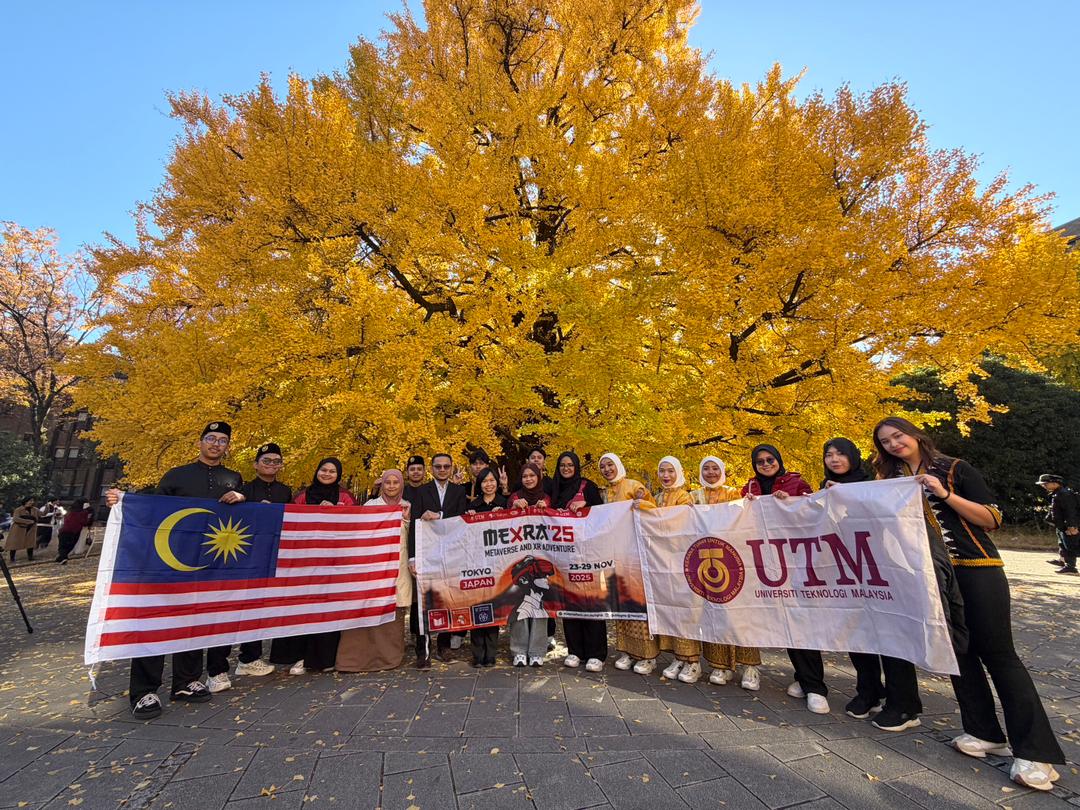

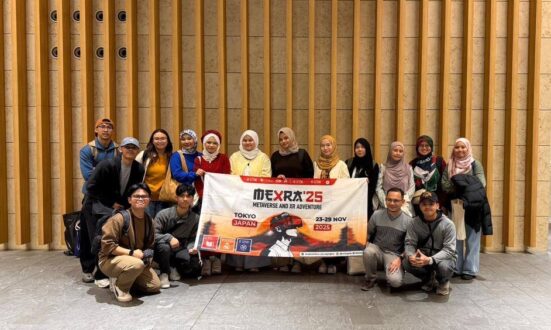
TOKYO, Nov 29 – Universiti Teknologi Malaysia (UTM), through the Faculty of Computing and Computer Graphics and Multimedia Association (CGMA), successfully conducted a Global Outreach Program (GOP), the Metaverse and XR Adventure (MEXRA’25) in Tokyo, Japan, from 23 to 29 November 2025.
The delegates from the Faculty of Computing comprise 13 students currently undertaking the Graphics and Multimedia Software (SECVH) degree programme, accompanied by Assoc. Prof. Ts. Dr. Farhan Mohamed, Head of the Department of Emergent Computing; Dr. Nur Zuraifah Syazrah Othman, Student Development Coordinator; and Nor Kamsiah Manan, Assistant Registrar.
MEXRA ’25 was designed as a holistic international learning initiative that integrates academic knowledge transfer, industry engagement, and cultural immersion through its subprograms Virtual Insights and MetaConnect. This reflects UTM’s ongoing commitment to strengthening global engagement, advancing future-ready digital competencies, and nurturing globally minded graduates.
Virtual Insights: Engagement with Industries
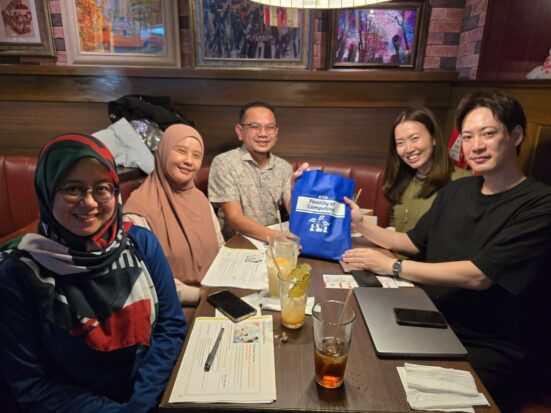
On 24 November, a collaboration dialogue with GPC Tokyo (Tsuyokute New Game Co., Ltd.), a Japan-based game development company, was held. During the session, GPC Tokyo shared insights into their game development workflows, content production strategies, and professional training initiatives. As part of the knowledge-exchange process, GPC Tokyo extended an offer of complimentary course access to UTM, allowing a faculty member to formally enrol in the program and provide structured feedback on course content.
The discussion further explored curriculum alignment opportunities, with UTM sharing elements of its game development academic curriculum to identify potential synergies between industry-based training and university-level instruction. Both parties expressed interest in formalising collaboration through appropriate non-disclosure and licensing agreements, laying the groundwork for future initiatives such as curriculum enrichment, industry-informed teaching materials, and collaborative training activities.
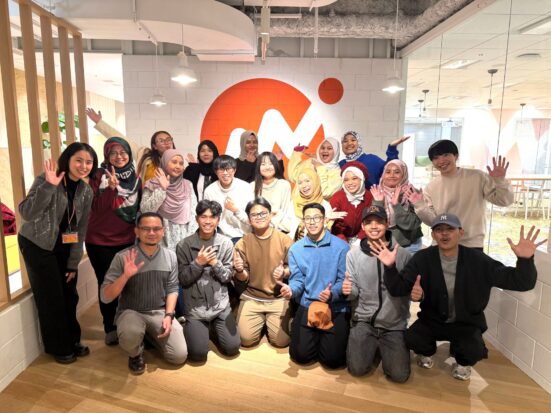
On 26 November, the Virtual Insights subprogram activity continues with a visit to Money Forward Inc., a leading Japanese financial technology company, where participants were exposed to real-world fintech operations, organisational culture, and innovation practices within a global corporate environment.
A key knowledge-transfer component of the visit was a mini workshop on the “Value & Aspiration Map” facilitated by Money Forward representatives. Through guided activities and structured discussion, students were encouraged to reflect on their personal values, aspirations, and motivations and to examine how these internal drivers influence career decisions, professional behaviour, and long-term goals. The session provided students with a practical framework to connect self-awareness with workplace expectations, offering a meaningful perspective on workplace identity and professional direction.
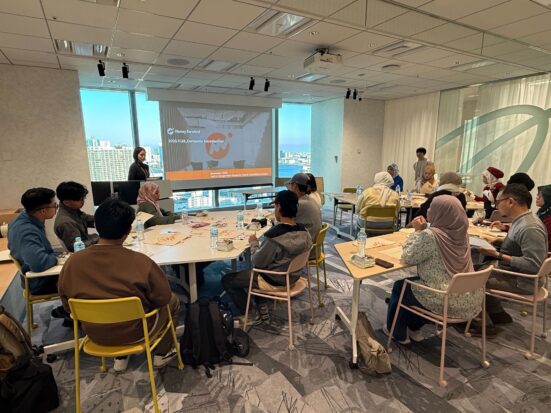
A sharing session was then presented by UTM alumni, Ong Yue Huei and Low Tian Sheng, both Faculty of Computing graduates of the SECVH degree programme and currently working at Money Forward Inc. They shared insights into their professional journeys, adaptation to Japanese corporate culture, and career progression in the technology sector.
In addition to the immediate learning outcomes, discussions during the visit also explored future collaboration on internship placement opportunities for UTM students at Money Forward Inc. This proposed collaboration aims to create structured pathways for students to gain hands-on industry experience, strengthen workplace readiness, and develop cross-cultural professional competencies. Such initiatives align with UTM’s graduate employability agenda by bridging academic learning with industry practice and enhancing students’ career prospects.
MetaConnect: Academic Exchange and Research Exposure
The highlight of MEXRA ’25 took place on 28 November at the renowned University of Tokyo (UTokyo) through the MetaConnect subprogramme, which served as a structured knowledge-transfer and academic exchange platform between UTM and UTokyo. The delegation was welcomed by representatives from the UTokyo Department of Technology Management for Innovation, Prof. Kenji Tanaka and Prof. Nariaki Nishino, together with Dr. Amy Poh Ai Ling of the Department of Precision Engineering.
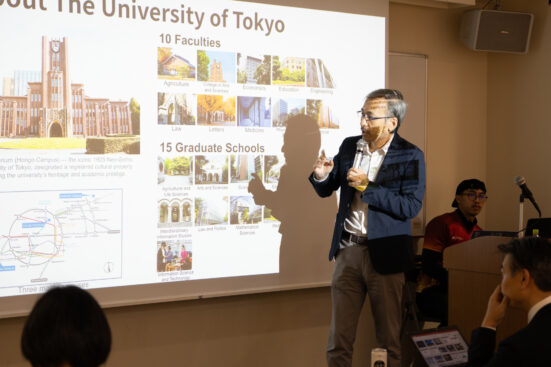
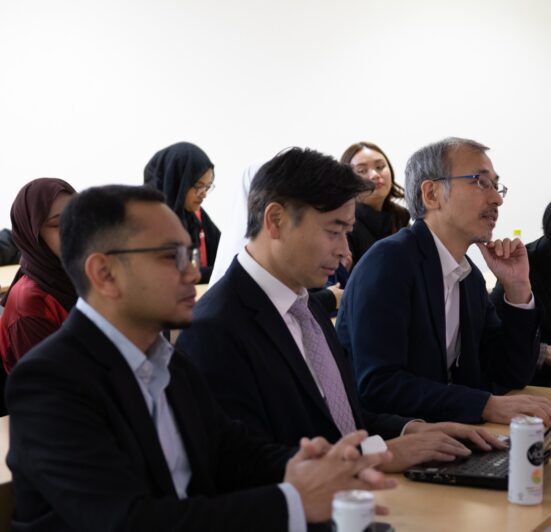
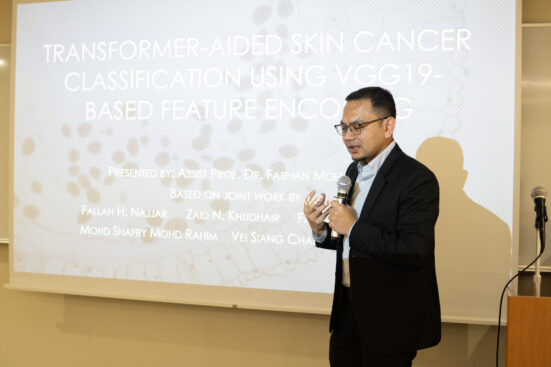
A central component of MetaConnect was academic knowledge-sharing talks delivered by representatives from both institutions. Dr. Farhan delivered a talk titled “Advancing Medical Imaging with Artificial Intelligence”, highlighting how AI-driven approaches are transforming medical imaging through improved accuracy, efficiency, and clinical decision support. In return, Dr. Amy represented UTokyo with her talk titled “BattreLife: Enabling Sustainable Second-Life Electric Vehicle Battery Ecosystems through Smart Manufacturing and Policy Innovation towards the Circular Economy in Malaysia”, which introduced participants to sustainability-driven design thinking and the role of technology in enabling circular economic models.

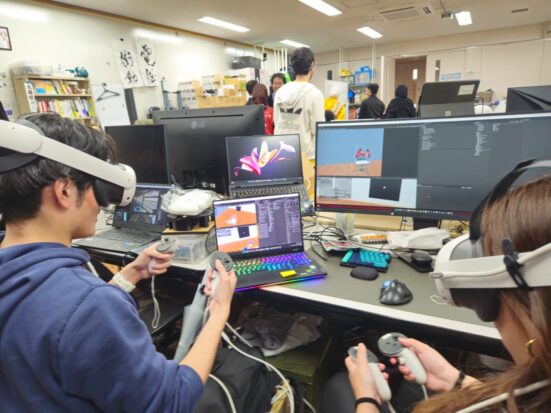
Further knowledge exchange ensued through a visit to the Cyber Interface Lab, headed by Prof. Takuji Narumi, known for its research in human–computer interaction, Extended Reality (XR), interactive systems, and immersive technologies. Students were exposed to ongoing research projects and experimental platforms, gaining a deeper understanding of how advanced research is integrated into academic programmes and innovation ecosystems at UTokyo.
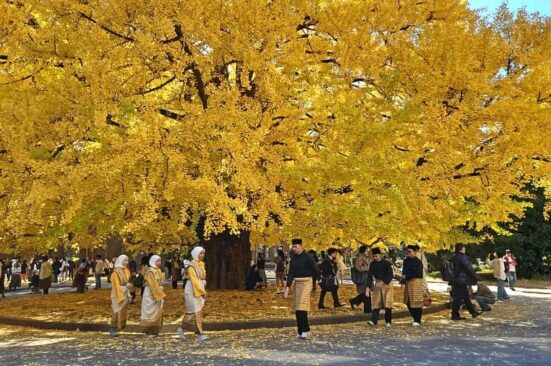
Participants were then brought to the University of Tokyo Museum, providing a broader interdisciplinary and historical context to UTokyo’s research culture. To close MetaConnect, UTM students were invited to perform two traditional dances under the famed Ginkgo Tree of UTokyo, showcasing Malaysian heritage to the Japanese public.
The MetaConnect subprogramme strengthened academic ties between UTM and UTokyo by facilitating two-way knowledge transfer, interdisciplinary dialogue, and exposure to global research practices, while laying a foundation for future collaboration. Plans are underway to continue reciprocal invitations for UTokyo research experts to deliver talks at UTM and to explore the establishment of a formal Memorandum of Understanding (MoU) to support long-term academic and research collaboration.
Cultural Immersion and Experiential Learning in the heart of Japan
Throughout the week, participants also enjoyed a rich exposure to Japanese culture and heritage through visits to a wide range of cultural, historical, and urban sites across Tokyo and its surrounding regions. Exploration of locations such as Asakusa, Senso-ji Temple, Nakamise Street, and Chokokuji Temple provided participants with deeper insights into Japanese history, traditional architecture, and local cultural practices, while fostering appreciation for community values and long-standing traditions.
Visits to Shin-Okubo and Akihabara further broadened participants’ understanding of contemporary cultural interactions, technology, and Japan’s digital entertainment landscape, illustrating how modern lifestyles and technological innovation coexist within Japan’s urban culture. Additional visits to the National Museum of Nature and Science, Ueno Park and Ameyoko Street offered insights into Japanese art, science, and society, complementing cultural explorations at Meiji Jingu Shrine, Yoyogi Park, Harajuku, and Shibuya. Together, these experiences highlighted the harmonious blend of history and modernity in Japan and provided participants with a holistic understanding of how traditional values coexist with contemporary industries such as fashion, retail, and urban development.
Experiential learning was further enriched through engagement with the natural and cultural landscapes of the Mount Fuji region, including visits to Arakurayama Sengen Park, Oshino Hakkai, the Maple Corridor, and selected local community sites. Exposure to these environments deepened participants’ perspectives on the relationship between culture, nature, and Japanese identity, while fostering appreciation for heritage conservation and stimulating creativity through visual inspiration.

Conclusion
The MEXRA ’25 programme stands as a meaningful international initiative that successfully combined academic exchange, industry engagement, cultural immersion, and knowledge transfer. Beyond technical exposure to Metaverse and XR technologies, the programme fostered personal growth, global awareness, and professional readiness among participating students.
The organising committee extends its appreciation to the Student Affairs and Alumni (HEPA), UTM International and Vida World Sdn. Bhd. for their generous support and sponsorship, which made this meaningful learning opportunity possible.
Article by Dr. Nur Zuraifah Syazrah Othman and Nadia Syahadah Saharudin
