
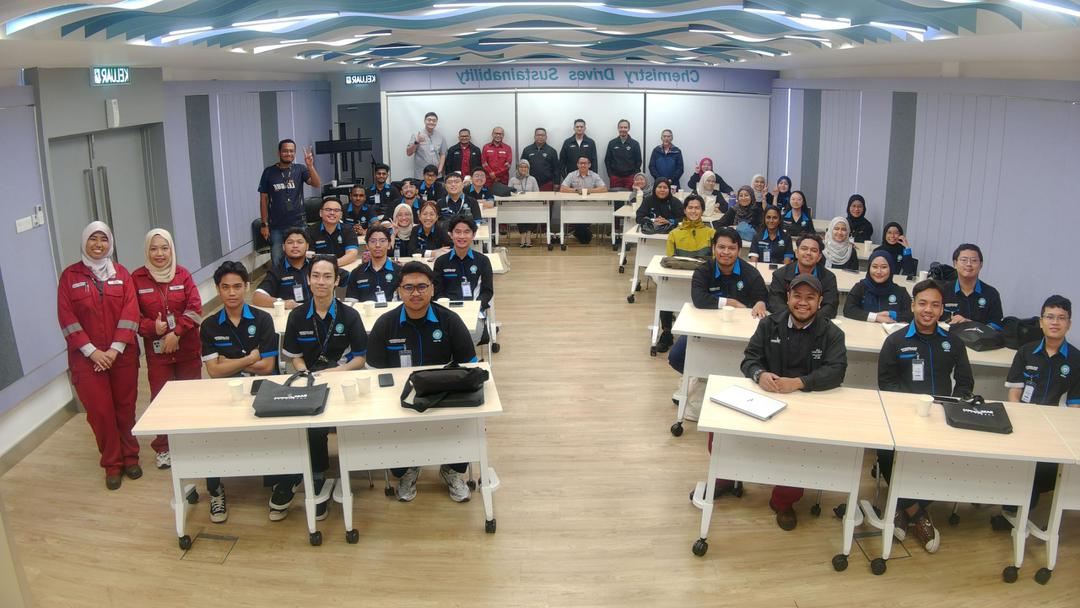

KUANTAN, Nov 27 — A total of 35 students from the Bachelor of Chemical Process Engineering with Honours (SMJCH) programme at the Malaysia-Japan International Institute of Technology (MJIIT), Universiti Teknologi Malaysia (UTM), undertook an industrial immersion visit to BASF PETRONAS Chemicals Sdn. Bhd. (BPC) in Gebeng, Pahang. Organised as an activity under the Chemical Process Engineering Student Society in partnership with the Chemical Plant Design Project courses (SMJC4343), the visit aimed to strengthen students’ understanding of real-world petrochemical operations while deepening MJIIT’s collaborative ties with leading industry partners.
The engagement reflected MJIIT’s ongoing commitment to bridging academic learning with industrial relevance. Upon arrival, students were welcomed by BPC’s engineers and technical specialists, including General Manager Godseth Menezes and Senior Managers of the Acrylic Complex. The briefing session provided an in-depth introduction to the company’s operations, highlighting BPC’s integrated petrochemical value chain, which transforms upstream feedstocks into high-value acrylic monomers, oxo products, and specialty chemicals. The insights offered students a clearer picture of how complex reaction and separation systems are coordinated on a plant-wide scale.
A strong emphasis was placed on operational excellence and process safety—core priorities within the BASF global network. Engineers explained how to interpret Process and Instrumentation Diagrams (P&ID), and shared details about safety, reliability, and sustainability practices embedded in daily plant operations. Students also gained valuable insights into BPC’s low-carbon and sustainability commitments, which resonate closely with MJIIT’s focus on responsible engineering and sustainable development.
The managers and engineers further discussed industry competency expectations and career development pathways, offering students a better understanding of the skills and attributes needed to thrive in the petrochemical sector. Notably, many members of the BPC team hosting the visit are UTM alumni, strengthening the connection between academic preparation and industry practice. Constructive exchanges throughout the session highlighted opportunities for deeper collaboration in student projects, industrial-based research, and future talent development.
During the facility tour, students observed processing units, utility infrastructure, and plant control systems firsthand. This exposure enabled them to connect theoretical concepts from their coursework with real-world industrial applications. Walking through the plant environment allowed students to appreciate the intricacies of process flows, equipment functions, and safety considerations that underpin large-scale chemical production. The experience was particularly valuable for those preparing their capstone design projects, as it helped them visualise industrial constraints, layout considerations, and practical engineering decisions beyond textbook learning.
The visit significantly enriched students’ learning experience and supported their development of professional competencies. Discussions on plant optimisation and sustainability encouraged them to think more critically about efficiency, environmental impact, and innovation in process design. Observing equipment scale, instrumentation, utility integration, and plant workflows sharpened their ability to justify engineering decisions in their capstone designs. At the same time, direct engagement with industry professionals motivated students to reflect on their readiness for industrial training and future careers, reinforcing the importance of communication, teamwork, and problem-solving skills emphasised in MJIIT’s curriculum.
MJIIT extends its heartfelt appreciation to BASF PETRONAS Chemicals Sdn. Bhd. for the warm hospitality, insightful knowledge sharing, and continuous support in nurturing the next generation of chemical engineers. Special gratitude is extended to Abdul Syakir Abdul Wahab, a member of the second cohort of the Bachelor of Chemical Process Engineering (Class of 2018) and currently Senior Executive Production Engineer, who initiated and coordinated the visit. MJIIT looks forward to strengthening future collaborations in teaching, research, and talent development to ensure that its graduates continue to meet the evolving needs of Malaysia’s petrochemical and industrial sectors.


